
Death Countdown: How Many Days Until I Die?
This death countdown turns your life expectancy into days, hours, minutes and seconds. For adults in high-income countries it ranges from over 21,000 days at age 20 to about 3,600 at age 80. Enter your birth date, sex and country to see your own number, and the everyday changes that add days back. It uses the same model as our death clock.
- UN 2024 data, 201 countries
- Nothing stored or sent
- Free, no sign-up
Days left, on average
On this page
How the death countdown is calculated
The countdown starts from the same estimate as our full calculator. We find the average number of years people with your age, sex, country and answers still live. Then we turn those years into days and count down to that point, second by second.
- Your birth date gives your exact age today.
- Your country and sex set a survival curve, tuned to UN World Population Prospects 2024.
- Optional answers such as BMI, smoking and exercise raise or lower risk a little at every age.
- The remaining years become days: years multiplied by 365.24.
- The timer ticks down from the projected moment, and the bar shows days lived against days left.
How many days do I have left to live?
Here is a quick guide from our model for healthy non-smokers in the United States. Use the tool above for your own number.
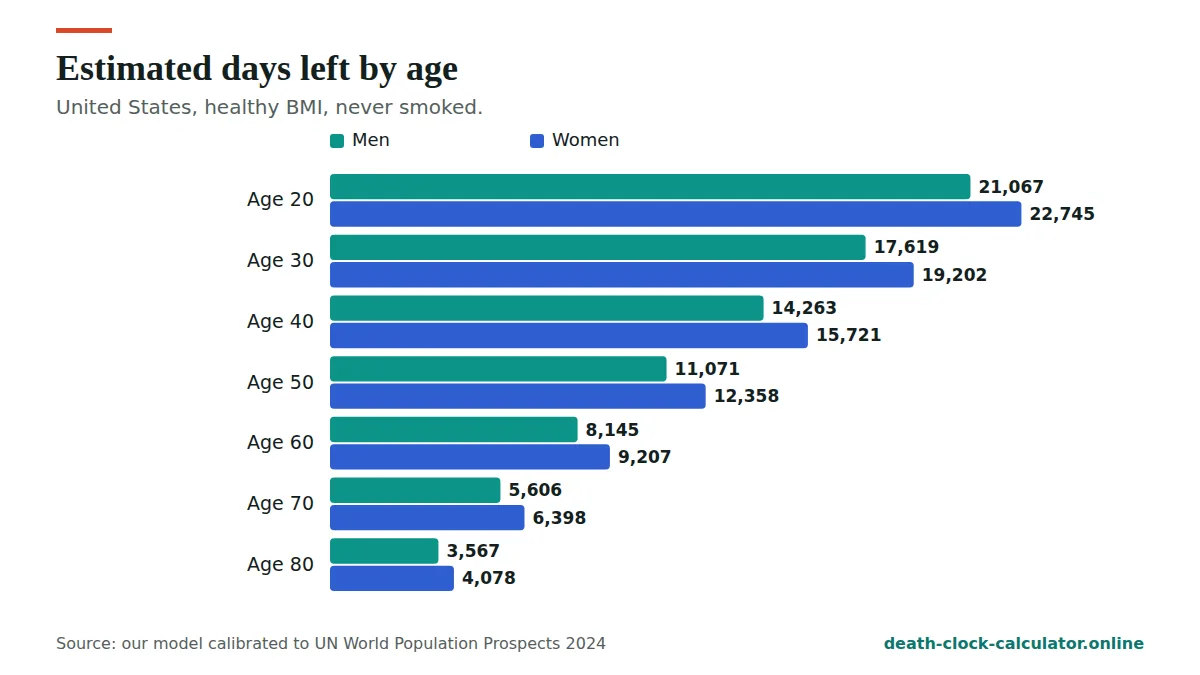
| Age today | Men: days left | Women: days left |
|---|---|---|
| 20 | 21,067 | 22,744 |
| 30 | 17,619 | 19,202 |
| 40 | 14,263 | 15,720 |
| 50 | 11,071 | 12,357 |
| 60 | 8,144 | 9,206 |
| 70 | 5,605 | 6,398 |
| 80 | 3,566 | 4,077 |
A 30-year-old American man has about 17,600 days ahead on average. That is more than 2,500 Saturdays.
Why does my countdown change when I change my answers?
Because each answer changes the risk the model uses at every future age. Quitting smoking, moving more or reaching a healthy weight lowers that risk, and the curve stretches out. The timer shows this straight away, in days.
The countdown also shifts slightly as you get older. Every year you live, you pass risks that pulled the average down. So your projected date moves a little later over time. This is normal and is the same effect you can see on our life expectancy by age tables.
Is a death timer accurate?
The number of days is an average, not a deadline. Many people with your answers live well beyond it, and some don’t reach it. The real spread is often more than 15 years, which is 5,000 days or more. Read is the death clock real? for what these numbers can and can’t tell you.
Days, weeks or years: which is best to think about?
Years are easy to compare but hard to feel. Days feel more real, which is why many people prefer a countdown. Weeks sit in between: an average 30-year-old has a little over 2,500 weeks ahead. Some people find it helpful to think in things they care about instead: summers, holidays, birthdays with their children. Whatever unit you use, remember the number is an average for people like you, and the range around it is wide.
A healthier way to use a death countdown
Many people use a life countdown as a nudge, not a worry. Some ideas:
- Use the “ways to add days” list to pick one habit to work on this month.
- Think in weekends, summers or visits with people you love, not in years.
- Check back in a few months after a change. Your countdown will reflect it.
If the number worries you, that is a normal reaction. Close the page, take a breath, and talk to someone if it stays with you.
Prefer a date or an age instead of days? Try the death date calculator or what age will I die, or the step-by-step when will I die quiz.
Death counter or death countdown: what is the difference?
The two names are often used for the same thing, but they point in opposite directions.
- A death counter counts up. It shows how many days you have already lived since the day you were born.
- A death countdown counts down. It shows how many days are left until the average date of death for people like you.
Our tool shows both at once. The bar under the timer compares days lived with days left, and the big number counts down. If you searched for a death counter to track deaths in a video game or a live stream, that is a different kind of tool. This page is only about life expectancy.
What the ticking seconds mean
A day has 86,400 seconds, so a death timer that shows seconds looks very exact. It isn’t, and it doesn’t claim to be. The seconds are just the daily average broken into smaller pieces so you can watch it move. The real uncertainty around your number is measured in thousands of days. If you want one honest line to remember, it is this: the question “how many days until I die?” has an average answer, never an exact one.
Days lived and days left: reading the progress bar
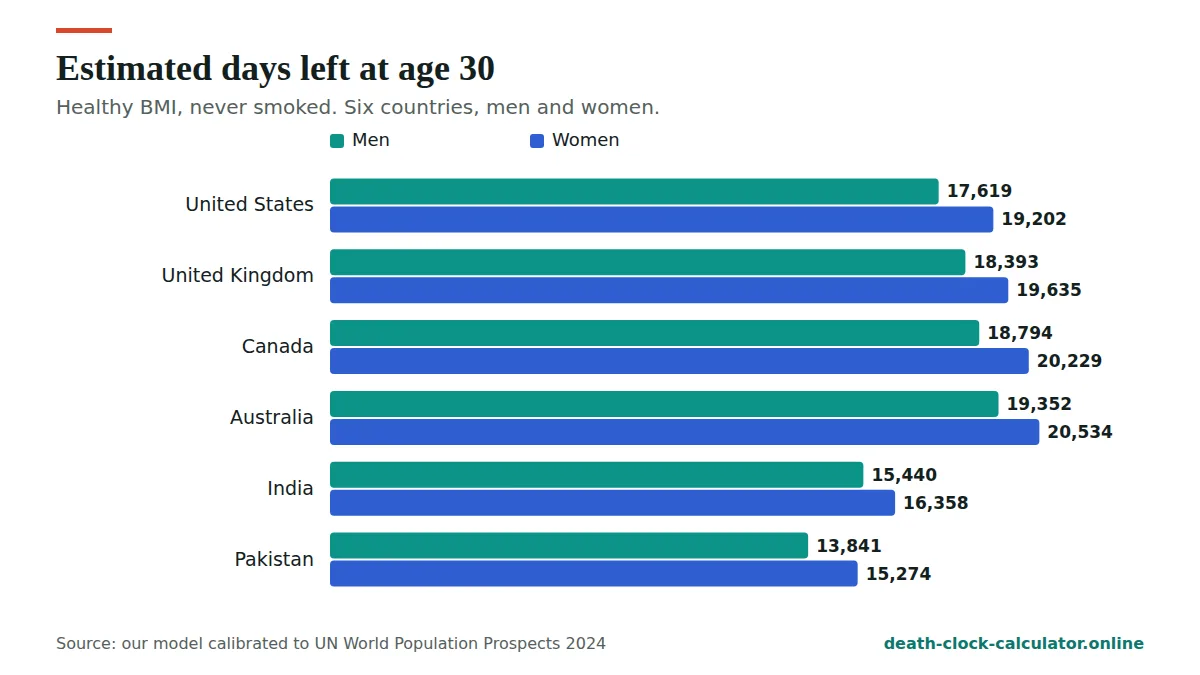
The bar is a simple picture of where you stand. It takes the days you have lived and puts them next to the average days left for people like you. Here is how it fills up for healthy American men who never smoked.
| Age today | Days lived | Average days left | Share already lived |
|---|---|---|---|
| 20 | 7,305 | 21,067 | 26% |
| 30 | 10,957 | 17,619 | 38% |
| 40 | 14,610 | 14,263 | 51% |
| 50 | 18,262 | 11,071 | 62% |
| 60 | 21,914 | 8,144 | 73% |
| 70 | 25,567 | 5,605 | 82% |
| 80 | 29,219 | 3,566 | 89% |
For this group, the halfway point falls at about 40. For women the bar fills more slowly, because they have more days left at every age. A 40-year-old American woman in the same model has about 15,720 days ahead, so she has lived a little under half of her average total.
Keep in mind that the bar shows an average. For half of the people in any group, the real bar would stretch further to the right.
Why the death timer runs slower than the calendar
Here is something that surprises many people. When ten years pass on the calendar, your countdown does not drop by ten years of days. It drops by less.
Take the same American men. Between 30 and 40, about 3,652 days go by. But the average days left falls from 17,619 to 14,263, a drop of only 3,356. The other 296 days are, in effect, handed back. Later in life the effect grows:
- From 30 to 40: 3,652 days pass, the countdown falls by 3,356.
- From 50 to 60: 3,652 days pass, the countdown falls by 2,927.
- From 70 to 80: 3,652 days pass, the countdown falls by 2,039.
The reason is survivorship. Each year you live, you leave behind a year of risk that some people in your group did not get through. The average for those still here moves later. So the death timer on your screen is honest for today, but if you come back in ten years, you will likely find more days left than a simple subtraction would suggest.
Checking back after a month
If you look at the countdown once a month, you can see this effect on a small scale. For a healthy American man between 30 and 40, the count falls by about 28 days a month on average, not 30. Between 70 and 80 it falls by only about 17 days a month. These are averages across ten years, taken from the table above, and your own count will also move whenever you change an answer. A death countdown that falls more slowly than the calendar is not a bug. It is how survival works.
How many days until I die in the UK, Canada or Australia?
The table higher up covers the United States. Readers elsewhere often ask how their numbers compare. Here are the model’s figures for healthy 30-year-olds who never smoked.
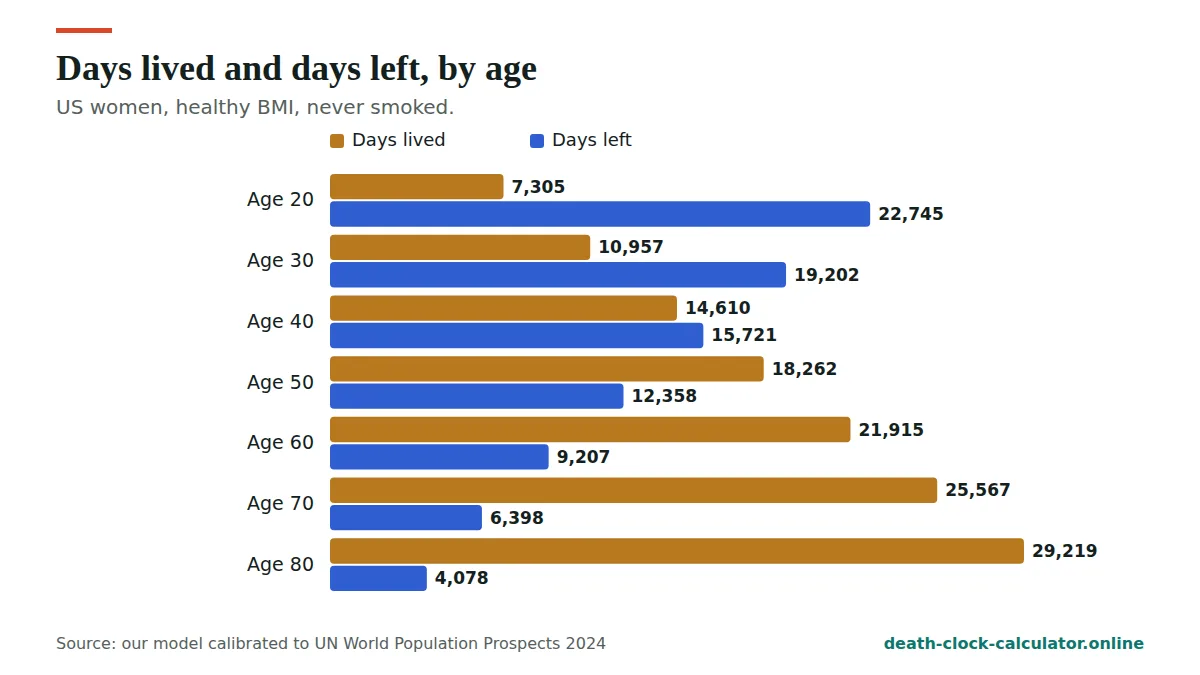
| Group, age 30 | Average days left | Same in years |
|---|---|---|
| United States, men | 17,619 | 48.2 |
| United States, women | 19,202 | 52.6 |
| Canada, men | 18,794 | 51.5 |
| United Kingdom, women | 19,635 | 53.8 |
| Australia, women | 20,534 | 56.2 |
A healthy 30-year-old woman in Australia has close to 3,000 more days ahead, on average, than a man of the same age in the United States. Most of that gap comes from sex and country, not from anything either person does. To see where your own country stands, visit life expectancy by country.
How long until I die if I am already 80?
Older readers sometimes brace for a very small number. The model gives more time than most expect. A healthy American man of 80 has about 3,566 days left on average, which is nearly ten years. A woman of the same age has about 4,077 days.
At 90, the average for a healthy American man is still about 5.7 years, or roughly 2,100 days. For a woman it is about 6.4 years, or roughly 2,300 days. Ages in the 90s are no longer rare in high-income countries, and each extra year lived pushes the average a little further out again.
At these ages, health on the day matters much more than any table. The countdown knows nothing about how you feel, how active you are or what your doctor has told you.
A death countdown is not a medical prognosis
This point matters most for families. The death countdown uses averages for the general population of your age, sex and country. It does not know about any illness.
If you or someone you love has a serious condition, the numbers here do not apply in the usual way. Doctors who know the case can give a far better picture of what to expect. Please ask them, not an online timer.
The same goes for moments when you feel low. It is fine to skip the countdown entirely if you are grieving, have just had bad health news, or tend to worry late at night. If thoughts about death keep coming back, our death anxiety help page has calm, simple steps.
Getting a useful number from the countdown
A few small choices make the count more meaningful:
- Enter your exact birth date. A countdown works in days, so the day and month matter here more than on a yearly estimate.
- Pick the country where you have lived most of your adult life. Country is one of the biggest inputs.
- Answer the optional questions honestly. Your usual habits count, not your best week.
- Change one answer at a time. That way you can see exactly how many days each habit is worth.
If you would rather answer one question at a time, the when will I die quiz uses the same engine.
Frequently asked questions
How many days until I die?
Enter your birth date, sex and country above to see the average number of days left for people like you. As a rough guide, a healthy 30-year-old in the US, UK, Canada or Australia has about 17,500 to 21,000 days ahead on average. It is an average, not a deadline.
What is a death timer?
A death timer, death counter or death meter counts down to the average date of death for people like you, in days, hours, minutes and seconds. Ours uses the same model as our full death clock, based on UN data and published studies.
How long till I die?
Nobody can tell you exactly. On average, people like you have the number of days shown by the countdown, but many live much longer. Healthy habits can add thousands of days, and the “ways to add days” list shows which changes matter most for you.
Why does my death countdown change?
It changes when you change an answer, because each answer changes your risk at every age. It also moves slightly later as you get older, because every year you live you pass some of the risks that pulled the average down.
Is a death countdown healthy to use?
For many people it is a useful nudge to focus on what matters or change a habit. If it makes you anxious, close it. The number is only an average, and many people live far beyond it. If worry stays with you, talk to someone.
How many days until I die if I am 50?
For a healthy 50-year-old in the United States who never smoked, our model gives about 11,071 days left on average for men and 12,357 for women. That is around 30 to 34 years. Enter your own details in the tool above, because country and habits can move the number by thousands of days.
How many days until I die if I am 20?
For a healthy 20-year-old in the United States who never smoked, our model gives about 21,067 days left on average for men and 22,744 for women. That is close to 58 and 62 years. People who are 20 today will probably gain more days as health care improves, so treat these as cautious figures.
Does the death counter keep running when I close the page?
No timer runs in the background. Each time you enter your answers, the count is worked out fresh from your birth date and today’s date. Your answers stay in your browser. The seconds you see ticking are only a display of that daily average.
Why do women get more days on the death countdown?
Women live longer than men in every country in the UN data, by 5.2 years on average across 201 countries and territories. In our model, a healthy 30-year-old American woman has about 19,202 days left, against 17,619 for a man of the same age. The tool simply uses the matching survival curve.
Can I use a death timer for a relative who is ill?
It is better not to. The countdown uses averages for healthy people in the general population. It knows nothing about any illness, so it can mislead in either direction. The doctors treating your relative can give a far more useful picture. If the situation is weighing on you, see our death anxiety help page.
Are the days left all healthy days?
No. The countdown covers every remaining day on average, not only the days in good health. Nobody can promise how those days will feel, but the habits that add days, like not smoking and staying active, also tend to keep people well for longer. See our guide to living longer.
If you are feeling low
If this topic is weighing on you, please talk to someone today. You do not need to be in crisis to call.
- United States: call or text 988 (988 Suicide and Crisis Lifeline)
- United Kingdom and Ireland: Samaritans, call 116 123 for free
- India: Tele-MANAS, call 14416 (free, 24 hours, government of India)
- Anywhere else: findahelpline.com lists free, confidential helplines by country
If you are in danger right now, call your local emergency number.
For every input, the survival curve and full sources, use the full death clock calculator.
Data: United Nations, World Population Prospects 2024. Method: how we calculate.
See your own estimate in 30 seconds
Free, private and based on UN 2024 data for 201 countries. Nothing you enter is stored.
Open the death clock →