
Death Clock FAQ
This death clock FAQ answers the questions people ask most about death clocks, life expectancy and our calculator, each in about 60 words. Every answer is based on UN or WHO data or a named study. For your own estimate, use the death clock calculator, which takes about 30 seconds.
- UN 2024 data, 201 countries
- Nothing stored or sent
- Free, no sign-up
On this page
Death clock FAQ: the most asked questions
Is the death clock accurate?
It is accurate for groups and uncertain for one person. The averages come from UN life tables and large published studies. But people with exactly your answers die across a wide range of ages, often 15 years or more. That is why every result shows the middle half range next to the estimate.
Is this death calculator free and private?
Yes. It is free, with no sign-up. Everything is calculated in your browser, so your date of birth and answers are never sent to us or stored. The site is paid for by ads, and advertisers never see what you type.
Does this death clock use AI?
No. It uses the Gompertz-Makeham formula, first published in 1825 and 1860, with UN data and published studies. There is no artificial intelligence or machine learning. Every constant and weight is listed on our method page, so you can check the maths yourself.
Will I die today?
No calculator can answer that for one person on one day, and this one does not try. For almost everyone reading this, the chance of dying on any single day is very small. If you are asking because you feel frightened or unsafe, please talk to someone right now. The support lines below are free and confidential.
What does the middle half mean?
It is the range of ages in which the middle 50% of people with your answers die. A quarter of them die before the lower age and a quarter after the higher age. It shows how wide the real uncertainty is, which a single date hides.
How do I calculate my death date?
Enter your date of birth, sex and country in the calculator on this page. It works out your age today, finds the average years left for people like you in UN 2024 data, and adds them to today’s date. You get a projected month and year, plus a range.
What is the average age of death?
Worldwide, life expectancy at birth in 2023 was about 70.5 years for men and 75.9 for women (UN World Population Prospects 2024). In richer countries it is around 80 or higher. Adults can expect to live longer than these at-birth figures.
Is there a real AI death calculator?
A research model called life2vec was tested on Danish registry data and reported in 2023. It is not available to the public, and its authors say there is no official app or demo. Online tools using the “AI death calculator” name are not that model.
How many days until I die?
Enter your birth date, sex and country above to see the average number of days left for people like you. As a rough guide, a healthy 30-year-old in the US, UK, Canada or Australia has about 17,500 to 21,000 days ahead on average. It is an average, not a deadline.
Is my quiz data saved?
No. The quiz runs in your browser, and your answers are never sent to us or stored. When you close the page, they are gone.
What is the most common cause of death?
Worldwide, ischaemic heart disease is the leading cause of death in adults, followed by stroke. In WHO’s 2021 estimates, COVID-19 was also near the top because of the pandemic.
Is there a free death clock app?
Yes. Our death clock works as a free app on any phone. Add it to your home screen from this page, with no app store, no account and no subscription. It opens full screen and works offline.
What is the full form of BMI in death clock?
BMI stands for Body Mass Index. It is your weight in kilograms divided by your height in metres squared. The death clock uses it because risk of death is lowest at a BMI of about 20 to 25.
How many people die in a second?
About 2 people die every second worldwide, based on the UN estimate of about 63.6 million deaths in 2026. In the same second, about 4 babies are born.
Why is my death clock result higher than the life expectancy for my country?
Because life expectancy at birth counts everyone, including people who die young. Once you have reached your current age, those early risks are behind you. So your expected age at death is higher than the at-birth figure, and it keeps rising as you get older. This death clock FAQ explains it under questions about your result.
Does the death clock work for children?
It can calculate for any age, but it is built for adults who want to understand averages. For children, the result is close to their country’s life expectancy at birth. If a child is worried about death, talk with them gently rather than showing them a calculator. Our death anxiety help page has simple tips.
Why does my result not change much when I add healthy habits?
If you already have a healthy BMI and have never smoked, the estimate starts from those healthy settings, so there is less to add. The biggest changes come from stopping smoking and moving out of the highest BMI bands. The inputs section of this death clock FAQ gives example figures from our model.
Can I share my death clock result?
Yes, if you want to. Your answers stay in your browser and are not sent to us. If you share a result, remember it is an average for a group, not a prediction about you. Some people find it more useful to share the list of changes that add years than the date itself.
Where can I read more after this death clock FAQ?
Start with is the death clock real? for accuracy, then how we calculate for the formula and constants. Our death clock resources page lists every tool, guide and data file on the site in one place, so you can find the next page to read.
Death clock FAQ: questions about your result
This part of the death clock FAQ explains the numbers you see after you press calculate. Like every answer in our death clock FAQ, it uses our model and UN data. If a word is new to you, the life expectancy glossary explains it in plain English.
Why is my estimated age at death higher than life expectancy at birth?
Because you have already lived to your current age. Life expectancy at birth includes everyone born in a year, including those who die young. Once you have reached 40 or 60, those early risks are behind you, so your expected age at death goes up. This is called survivorship.
In our model, a woman in the United Kingdom has a life expectancy at birth of 83.2. At age 80, her expected age at death is 90.6, which is 7.4 years higher. These are model estimates for people with a healthy BMI who never smoked.
Why does my result change as I get older?
Each birthday you survive moves you into a group whose weaker members have already died. For men in the United States, our model gives an expected age at death of 76.9 at birth, 79.1 at age 40 and 85.3 at age 70. These are estimates for people with a healthy BMI who never smoked. So a result that looks early at 30 will usually rise over time.
Why do men and women get different results?
Because women live longer than men in almost every country. Across the 201 countries and territories in UN World Population Prospects 2024 (2023 estimates), the average gap is 5.2 years. It ranges from 13.3 years in Ukraine to 0.4 years in Togo. The death clock starts from the figure for your sex, so the gap carries through to your estimate.
What is the projected death date, exactly?
It is the month and year when people with your answers reach their average age at death. It is not a day on which anything is expected to happen. Many people live well past it and some die before it. That is why the range sits right next to it.
Death clock FAQ: questions about the inputs
This section of the death clock FAQ covers the questions the calculator asks, and why each one is there. For a longer look at each input, see our guide to what BMI and the other inputs mean.
Why does my country change the answer so much?
Where you live shapes health care, clean water, food, income and safety. These differences show up clearly in the data. In UN World Population Prospects 2024 (2023 estimates), life expectancy at birth for women runs from 88.1 in Hong Kong to 54.7 in Nigeria. For men it runs from 82.8 in Hong Kong to 53.2 in Chad. See every country on life expectancy by country.
How much does smoking change the estimate?
A lot. Lifelong smoking takes about 10 years off on average, based on the Doll and Peto study (BMJ, 2004). Quitting wins much of that back. In our model, a man in the United Kingdom who smoked for 30 or more years and quits at 40 gains an estimated 9.3 years compared with smoking for life. Quitting at 60 still gains an estimated 2.9 years.
How much does BMI change the estimate?
It depends on the band. Risk is lowest at a BMI of about 20 to 25. For a 40-year-old man in the United Kingdom who never smoked, our model takes off 3.6 years for a BMI of 30 to 34.9 and 9.6 years for a BMI of 40 or more. These use hazard ratios from the Global BMI Mortality Collaboration (Lancet, 2016).
Do I have to answer every question?
No. Date of birth, sex and country are enough for a basic estimate. The habit questions are optional. Answering them makes the result closer to people like you, and it shows which changes would move your estimate the most.
Death clock FAQ: chances of reaching an age
Many readers ask about the odds of reaching a birthday rather than a date. This part of the death clock FAQ answers that with our model. It is one of the most useful tables in the whole death clock FAQ, because it shows how wide the spread of outcomes really is.
| Group | Reach 70 | Reach 80 | Reach 90 | Reach 100 |
|---|---|---|---|---|
| United States, men | 76% | 52% | 23% | 4% |
| United States, women | 84% | 64% | 34% | 7% |
| United Kingdom, men | 82% | 59% | 24% | 2% |
| United Kingdom, women | 87% | 68% | 35% | 6% |
| India, men | 63% | 35% | 10% | 1% |
| India, women | 69% | 42% | 14% | 1% |
These are shares of large groups, not personal odds you can bank on. To see the chances for your own age and country, use what age will I die.
Can I use the death clock for retirement planning?
It can help you think, but plan for a longer life than the average. If you save for the average age, about half of people like you would outlive their money. Many planners choose an age that only 1 in 4 or 1 in 10 people reach. Our life expectancy calculator shows those planning ages. For money decisions, talk to a qualified adviser.
Death clock FAQ: questions about the countdown
The live countdown is the part people remember most. This part of the death clock FAQ explains what it is and what it is not.
Why does the countdown show seconds if it is only an average?
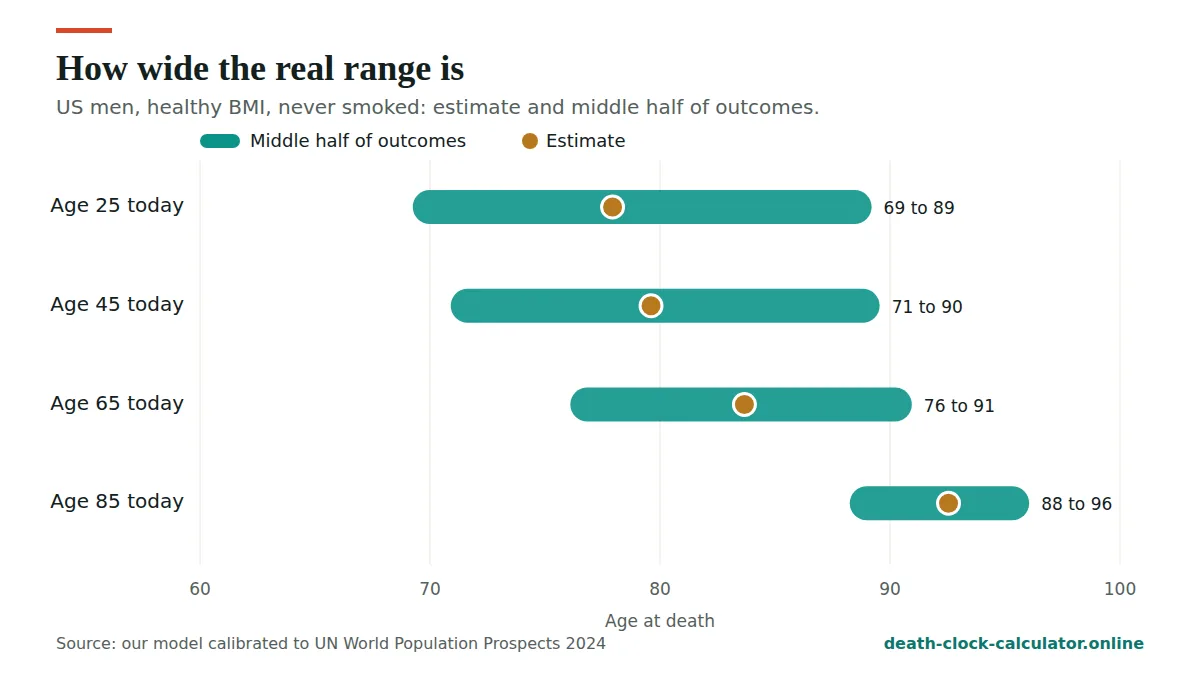
The seconds are there to make time feel real, not to suggest precision. The countdown simply counts to the projected month and year. The true uncertainty is measured in years. For a 25-year-old man in the United States, the middle half of outcomes in our model runs from 69 to 89, a window of 20 years.
Can I turn the countdown off?
You don’t have to look at it. If a ticking clock feels stressful, focus on the range and the “what moves your estimate” panel instead, or simply close the page. Our death countdown page explains the timer in more detail.
Death clock FAQ: data, updates and limits
The last group of questions in this death clock FAQ is about where the numbers come from and what no calculator can know.
Which year’s data does the death clock use?
Country figures come from UN World Population Prospects 2024, using the estimates for 2023. We check for new releases at least every six months and update within a month of a new UN or WHO release. The full list is on our data and sources page.
What can the death clock not tell me?
- Your personal date. It gives an average for a group, with a wide range.
- Your cause of death. It can show common causes for groups, not what will happen to you.
- The effect of illnesses it does not ask about. A diagnosis, treatment or family history can matter a great deal.
- Future medical progress. Our figures are based on today’s death rates.
If you have symptoms or a health condition, your doctor is the right person to ask, not a calculator.
Why does another calculator give me a different answer?
Tools use different data, years and methods, and some don’t adjust for your current age at all. Our method is public, and so is every source behind this death clock FAQ, so you can check every step on how we calculate. A tool that gives one exact date without a range is claiming more than anyone can know.
Death clock FAQ for first-time users
New to the calculator? These steps from the death clock FAQ will help you get a clear, calm result the first time.
- Start with the basics. Enter your date of birth, sex and country. That alone gives a fair estimate.
- Add the habits you know. Answer the optional questions honestly. Skip any you are unsure about.
- Read the range first. The middle half shows where most people like you fall. The single date is only the middle point.
- Look at what moves your estimate. This shows which changes would add the most years.
- Come back to the death clock FAQ if anything on the result is unclear.
How to use this death clock FAQ
This death clock FAQ is meant to be read in any order. Here is a quick guide to where each kind of question is answered.
| If you want to know | Where to look |
|---|---|
| If the death clock is accurate | The main death clock FAQ list above, and is the death clock real? |
| What a result means | Questions about your result, in this death clock FAQ |
| What each input does | Questions about the inputs, in this death clock FAQ |
| Your odds of reaching an age | Chances of reaching an age, in this death clock FAQ |
| The formula and constants | How we calculate |
| Help with worry about death | Death anxiety help |
If your question is not in this death clock FAQ, tell us through the contact page and we will consider adding it. And if reading about death leaves you uneasy, our gentle death anxiety help page is there for you.
If you are feeling low
If this topic is weighing on you, please talk to someone today. You do not need to be in crisis to call.
- United States: call or text 988 (988 Suicide and Crisis Lifeline)
- United Kingdom and Ireland: Samaritans, call 116 123 for free
- India: Tele-MANAS, call 14416 (free, 24 hours, government of India)
- Anywhere else: findahelpline.com lists free, confidential helplines by country
If you are in danger right now, call your local emergency number.
Data: United Nations, World Population Prospects 2024. Method: how we calculate.
See your own estimate in 30 seconds
Free, private and based on UN 2024 data for 201 countries. Nothing you enter is stored.
Open the death clock →