
Death Anxiety: Help If Thinking About Death Worries You
Death anxiety is fear or worry about dying or about death in general. Almost everyone feels it at some point, and it often shows up after an illness, a loss or seeing a number like a death clock result. It usually eases with time and support. If it is taking over your days, talking to someone helps, and free helplines are listed below.
- UN 2024 data, 201 countries
- Nothing stored or sent
- Free, no sign-up
If you are feeling low
If this topic is weighing on you, please talk to someone today. You do not need to be in crisis to call.
- United States: call or text 988 (988 Suicide and Crisis Lifeline)
- United Kingdom and Ireland: Samaritans, call 116 123 for free
- India: Tele-MANAS, call 14416 (free, 24 hours, government of India)
- Anywhere else: findahelpline.com lists free, confidential helplines by country
If you are in danger right now, call your local emergency number.
On this page
What is death anxiety?
Death anxiety means feeling scared, uneasy or preoccupied when you think about death, your own or someone else’s. Some people feel it as a passing jolt at night. Others find it hard to stop thinking about. It can come with a racing heart, trouble sleeping or checking your body for signs of illness.
Feeling this way does not mean something is wrong with you. Thinking about death is part of being human. It becomes a problem when it stops you enjoying life or doing everyday things.
Is it normal to feel upset by a death clock result?
Yes. Seeing a date or a countdown can feel personal, even when you know it is only an average. Remember three things:
- It is not your date. It is an average for thousands of people who gave the same answers. Many live far longer.
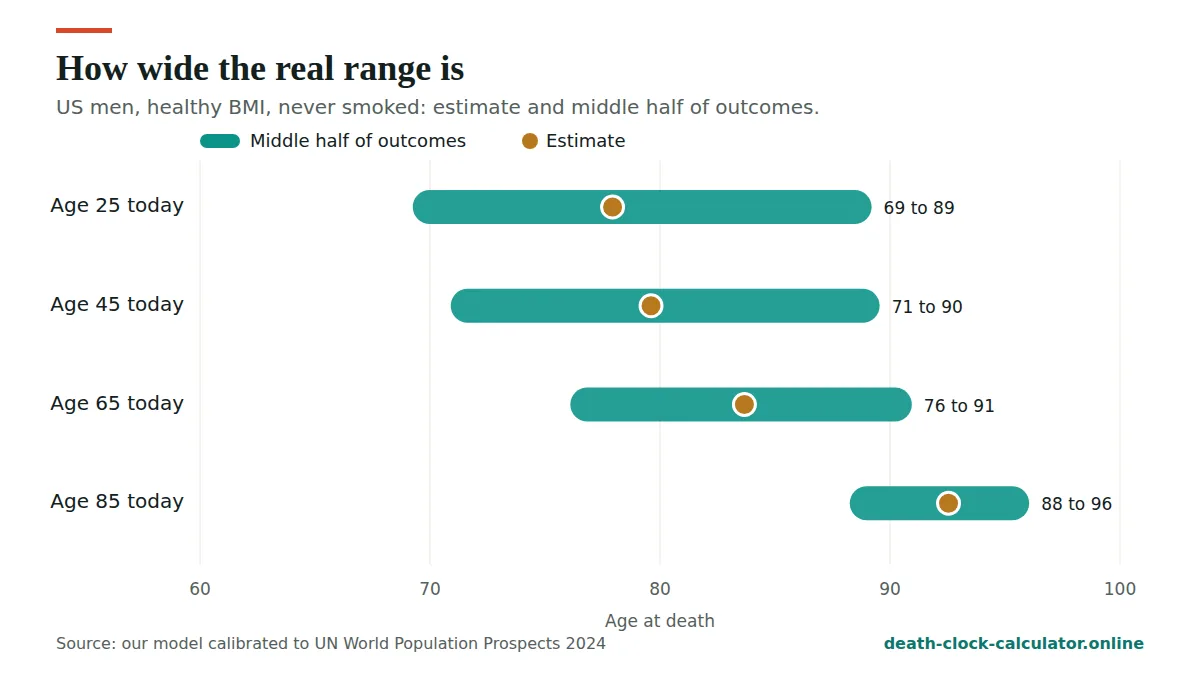
- The range is wide. Half of people like you die across a window of 15 years or more.
- Much of it is in your hands. The “what moves your estimate” panel shows real ways to add years.
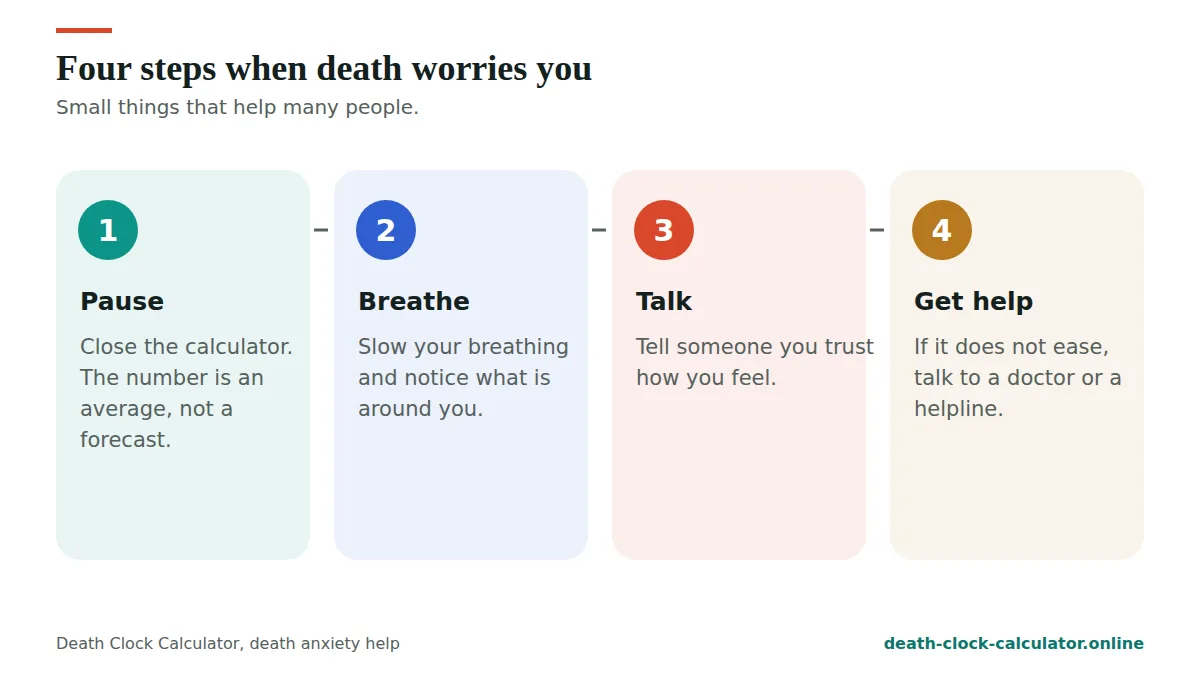
If the number keeps coming back to you, close the page and do something calming. You don’t need to look at it again.
What can help with death anxiety?
- Talk about it. Share the worry with a friend, relative or someone you trust. Saying it out loud often makes it smaller.
- Limit checking. Try not to keep searching symptoms or recalculating results. Set the topic aside for a while.
- Focus on what you can do. Pick one small healthy habit, like a daily walk. It helps your body and gives the worry somewhere useful to go.
- Look after sleep and routine. Worries feel bigger when you are tired.
- Stay connected. Time with people and doing things you value tends to ease worry about the future.
- Get professional help if it persists. Talking therapies, such as cognitive behavioural therapy, are widely used for anxiety. Your doctor can tell you what is available where you live.
When should I get help?
Talk to a doctor or counsellor if worry about death:
- lasts for weeks and doesn’t ease,
- stops you sleeping, working or seeing people,
- comes with panic attacks, or
- comes with thoughts of harming yourself.
If you are thinking about ending your life, or you are in danger right now, call your local emergency number or one of the helplines on this page straight away. You deserve support, and people are ready to listen.
Free helplines by country
| Country | Service | How to reach it |
|---|---|---|
| United States | 988 Suicide and Crisis Lifeline | Call or text 988 |
| United Kingdom and Ireland | Samaritans | Call 116 123, free, any time |
| India | Tele-MANAS (Government of India) | Call 14416, free, 24 hours |
| Anywhere | Find A Helpline | findahelpline.com lists free, confidential lines by country |
How to help someone with death anxiety
Listen without rushing to fix it. Let them say what scares them. Avoid “don’t be silly”. Gently encourage them to see a doctor if the worry is lasting or getting worse, and offer to help them make the call.
Common signs of death anxiety
Death anxiety can look different from person to person. Some people notice it in their thoughts first. Others feel it in their body before they can put a name to it. You might recognise a few of these:
- In your thoughts. Worry about dying that keeps coming back, “what if” questions late at night, or fear about what will happen to the people you love.
- In your body. A racing heart, tight chest, fast breathing, an upset stomach or feeling on edge.
- In what you do. Checking your pulse or body for signs of illness, searching symptoms again and again, or asking others for reassurance.
- In what you avoid. Keeping away from hospitals, funerals, news or even conversations that remind you of death.
Having some of these now and then is common. Death anxiety is worth paying attention to when these signs are frequent, hard to switch off, or start to shape your days.
What can set off death anxiety?
Death anxiety often has a trigger, even if it is not obvious at first. Knowing yours can make the feeling less confusing. Common ones include:
- the death of someone close, or of someone your own age,
- your own illness, a health scare or waiting for test results,
- a big birthday or another milestone that makes time feel shorter,
- becoming a parent or caring for someone who depends on you,
- frightening news stories or images,
- seeing a number about your life, such as a result from a calculator.
Sometimes death anxiety arrives with no clear reason. That is normal too. Stress, tiredness and big life changes can all make the mind turn to the biggest worries it has.
Why death anxiety often feels worse at night
Many people find their death anxiety is strongest in bed. The room is dark and quiet, there is nothing to distract you, and a tired mind is less able to put worries in proportion. A thought that seems manageable at lunchtime can feel huge at night.
A gentle night-time routine for death anxiety
- Put screens away before bed. Stop searching or reading about health and death in the hour before sleep.
- Write the worry down. Keep a notebook by the bed. Writing a thought on paper can help it leave your head for the night.
- Breathe slowly. Breathe in gently through your nose, then breathe out a little more slowly than you breathed in. Repeat until your body starts to settle.
- Get up if you can’t sleep. Go to another room and do something quiet and dull under a soft light, then return when you feel sleepy.
- Save big thinking for daytime. Tell yourself you will come back to the worry tomorrow, when you are rested.
A simple grounding exercise for death anxiety
When death anxiety rises quickly, your mind jumps into the future. Grounding brings your attention back to the present moment, where you are safe right now. It is a well-known way to calm a wave of anxiety, and you can do it anywhere.
- Look around. Name to yourself some things you can see, such as colours, shapes or light on a wall.
- Listen. Notice sounds near and far, like traffic, birds or the hum of a fridge.
- Feel. Pay attention to your feet on the floor, your back against the chair, or the texture of your clothes.
- Breathe. Let your breath slow down without forcing it.
The feeling may not vanish at once. That is fine. The aim is to let the wave pass, not to fight it. Like other waves, a wave of death anxiety rises, peaks and then falls.
Kinder ways to answer worried thoughts
Death anxiety often speaks in harsh, certain sentences. It can help to notice the thought and gently answer it with something more balanced. You don’t have to believe the new thought straight away. Just practise saying it.
| Worried thought | A calmer answer |
|---|---|
| “My result means I will die at that age.” | It is an average for a large group, with a wide range. It is not my date. |
| “This headache must be something serious.” | Most headaches are harmless. If I am worried, I can ask a doctor rather than searching. |
| “I should be thinking about this all the time to be ready.” | Worrying more does not keep me safer. Looking after my health and my relationships does more good. |
| “Everyone else copes, so something is wrong with me.” | Many people feel this way. Death anxiety is common, and it usually eases with support. |
| “I can’t stand this feeling.” | This feeling is uncomfortable, but it will pass. I have got through it before. |
Death anxiety and health anxiety
Death anxiety and health anxiety often go together. A small symptom leads to a search. The search shows frightening possibilities. That raises the fear, which makes you notice more symptoms. Then you check again. Each check brings a moment of relief, but the worry returns stronger.
Breaking this loop takes practice. A few steps that help:
- Delay the check. When you feel the urge to search or check your body, wait a while first. The urge often fades on its own.
- Use one trusted source. If a symptom is new or lasting, book a check with your doctor instead of reading many websites.
- Notice reassurance seeking. Asking others again and again can keep the worry going. Try to ask once, then let it rest.
- Keep up everyday life. Doing normal things, even while anxious, teaches your mind that you are safe.
If health worries take up a lot of your day, tell your doctor. Talking therapies are widely used for this pattern too.
Death anxiety after losing someone
Grief and death anxiety are closely linked. After a death, it is natural to think about your own life, or to fear losing someone else. You may feel you should be “over it” by now. There is no correct timeline for grief.
Be gentle with yourself. Talk about the person you lost, keep up small routines, and let others help with practical things. If grief feels stuck, or if you can’t function day to day, a doctor or bereavement counsellor can help.
Helping a child with worries about death
Children often ask about death after a pet dies, a grandparent is ill or they hear something at school. Their questions can be very direct. That is how they make sense of things.
- Use simple, honest words. Clear words like “died” are easier for children to understand than phrases like “went to sleep”.
- Answer what they ask. You don’t need to explain everything at once. Let them lead.
- Reassure them about safety. Tell them who looks after them and that most people live a long time.
- Share your family’s beliefs if you have them, in a way that suits their age.
- Watch for lasting changes in sleep, eating or mood, and talk to a doctor if they don’t settle.
How to use a death clock calmly if you have death anxiety
You don’t have to use a death clock at all. If you do, a little preparation can stop it feeding death anxiety.
- Check how you feel first. If you are already upset, tired or it is late at night, try another time.
- Read the range, not just the date. The result on our death clock always comes with a wide range, because nobody can know one person’s date.
- Look at what moves the estimate. The useful part is the list of changes that add years, such as not smoking and moving more.
- Calculate once. Going back again and again rarely helps. One look is enough.
- Close the page when you are done. Then do something you enjoy.
If you want to know how the estimate is made, and why it is an average, read is the death clock real? or our short death clock FAQ.
Talking to a doctor about death anxiety
Some people put off seeing a doctor because they think death anxiety is too small a reason. It is not. Doctors see worry and anxiety every day, and they would rather help early. It can help to plan what you want to say:
- what the worry is about, in your own words,
- how long it has been going on, roughly,
- how it affects your sleep, work, eating or relationships,
- any body symptoms, such as a racing heart or tight chest,
- anything that makes it better or worse.
You can write these points down and read them out. Your doctor can talk through options, such as talking therapies, and check any physical symptoms so you don’t have to keep wondering.
Finding meaning when death anxiety visits
For many people, death anxiety slowly turns into a clearer sense of what matters. Knowing that life is limited can make ordinary days feel more precious. Things people often find helpful include:
- Time with people you love. A call, a meal or a walk together.
- Faith or belief. Prayer, a place of worship or the traditions of your family, if they are part of your life.
- Doing something that lasts. Teaching, creating, volunteering or helping someone else.
- Time outdoors. Nature can give a calm sense of being part of something bigger.
- Noticing good moments. Some people like to end each day by thinking of one thing that went well.
Looking after your health can also turn worry into action. Our guide on how to live longer covers simple habits with real evidence behind them. If a reading from a chart or a name has upset you, our page on the astrology death calculator explains what those methods can and cannot tell you. And our death clock resources page gathers all of our guides in one place.
Frequently asked questions
Is death anxiety normal?
Yes. Most people feel worried about death at some point, often after a loss, an illness or a scary headline. It becomes a problem only when it stops you enjoying life or doing everyday things for weeks at a time.
How do I stop worrying about when I will die?
Talk to someone you trust, limit searching and recalculating, focus on one healthy habit you can control, and look after your sleep. If the worry lasts for weeks, a doctor or counsellor can help, and talking therapies work well for anxiety.
Should I be scared of my death clock result?
No. It is an average for thousands of people with the same answers, not your date. Many people live far beyond it, and the result comes with a wide range. If it upsets you, it is fine to close the page and not look again.
Where can I get help right now?
In the US, call or text 988. In the UK and Ireland, call Samaritans on 116 123. In India, call Tele-MANAS on 14416. Elsewhere, findahelpline.com lists free lines. If you are in danger, call your local emergency number.
Can death anxiety cause physical symptoms?
Yes. Death anxiety can cause a racing heart, a tight chest, fast breathing, an upset stomach and trouble sleeping. These are the body’s normal alarm response, and they pass. Because some symptoms can also have other causes, it is sensible to ask a doctor to check anything new or lasting, rather than searching online.
Why is my death anxiety worse at night?
At night there are fewer distractions, and a tired mind finds it harder to keep worries in proportion. Putting screens away before bed, writing the worry down and breathing slowly can help. If you can’t sleep, get up for a while and do something quiet before trying again.
Does death anxiety ever go away?
For most people, death anxiety comes and goes, and it usually eases with time, support and simple coping habits. It can return at stressful moments, such as after a loss. If it stays strong for weeks or stops you living normally, a doctor or counsellor can help you find what works.
Can children have death anxiety?
Yes. Children often worry about death after a loss, an illness in the family or something they heard. Answer their questions simply and honestly, let them lead, and reassure them about who looks after them. If changes in sleep, eating or mood don’t settle, talk to a doctor.
Is it OK to use a death clock if I have death anxiety?
You don’t have to use one. If you choose to, pick a calm moment, read the range rather than the date, and calculate only once. Our death clock shows averages for large groups, not your personal date. If a result upsets you, it is fine to close the page.
Want to understand what a death clock really shows? Read is the death clock real? or see how to live longer.
See your own estimate in 30 seconds
Free, private and based on UN 2024 data for 201 countries. Nothing you enter is stored.
Open the death clock →