
How to Live Longer: 7 Habits With Proven Gains
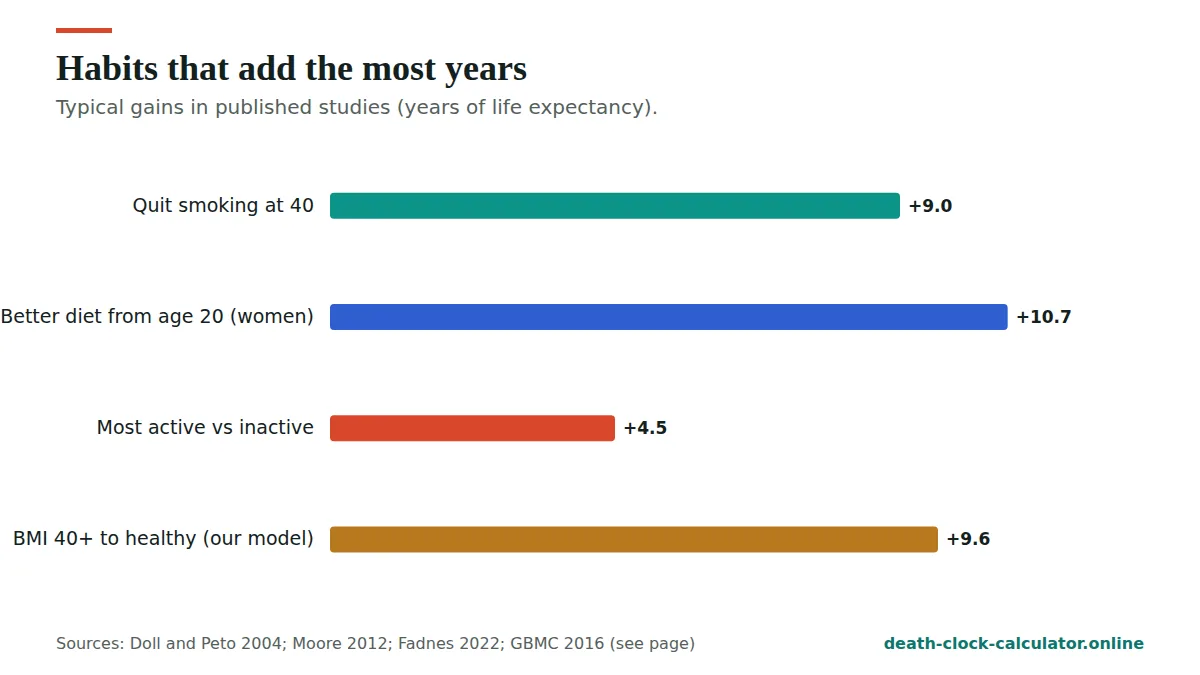
The habits that add the most years are well known and backed by large studies: don’t smoke, keep a healthy weight, move every day, eat mostly whole foods, drink little or no alcohol, keep blood pressure in check and stay connected to people. Quitting smoking by 40 alone wins back about 9 years. Here is how to live longer, with the evidence for each habit.
- UN 2024 data, 201 countries
- Nothing stored or sent
- Free, no sign-up
Want to see what these habits are worth for you? Run the death clock calculator and open the “What moves your estimate” panel.
On this page
Don’t smoke, or quit now
Smoking is the single biggest habit that shortens life. In a 50-year study of British doctors, lifelong smokers died about 10 years sooner than non-smokers. Quitting at 30 won back almost all of that, at 40 about 9 years, at 50 about 6 and at 60 about 3. It is never too late to gain something. See smoking and life expectancy.
Keep a healthy weight
A study of 10.6 million adults found the lowest death rates at a BMI of about 20 to 25. Above 25, each 5 extra points raised the death rate by about 31%. Small, lasting changes to what and how much you eat matter more than crash diets. Read BMI and life expectancy.
Move every day
In a pooled study of more than 650,000 adults, even about 75 minutes of brisk walking a week was linked with 1.8 extra years compared with no activity. The most active group gained about 4.5 years. The WHO suggests 150 to 300 minutes of moderate activity a week for adults, plus muscle strengthening twice a week.
Eat mostly whole foods and plants
A modelling study in PLOS Medicine estimated that changing from a typical Western diet to an optimal one at age 20 could add about 10 years for women and 13 for men, and still about 8 years if the change is made at 60. The biggest gains came from more legumes, whole grains and nuts, and less red and processed meat. The PREDIMED trial found a Mediterranean diet cut major heart events by about 30%.
Drink little or no alcohol
A large global analysis in The Lancet found that the level of drinking with the lowest overall health harm was zero. Risk rises with each extra drink. If you drink, drinking less helps.
Know your blood pressure
High blood pressure is a leading cause of heart disease and stroke, the top causes of adult deaths worldwide. It often has no symptoms, so the only way to know is to check. Many pharmacies do it free. See the most common causes of death by age.
Stay connected and find purpose
A review of 148 studies found that people with stronger social relationships had 50% higher odds of survival. Studies have also linked optimism and a sense of purpose with longer lives. Time with friends, family and community is good for more than your mood.
How to live longer: do these habits add up?
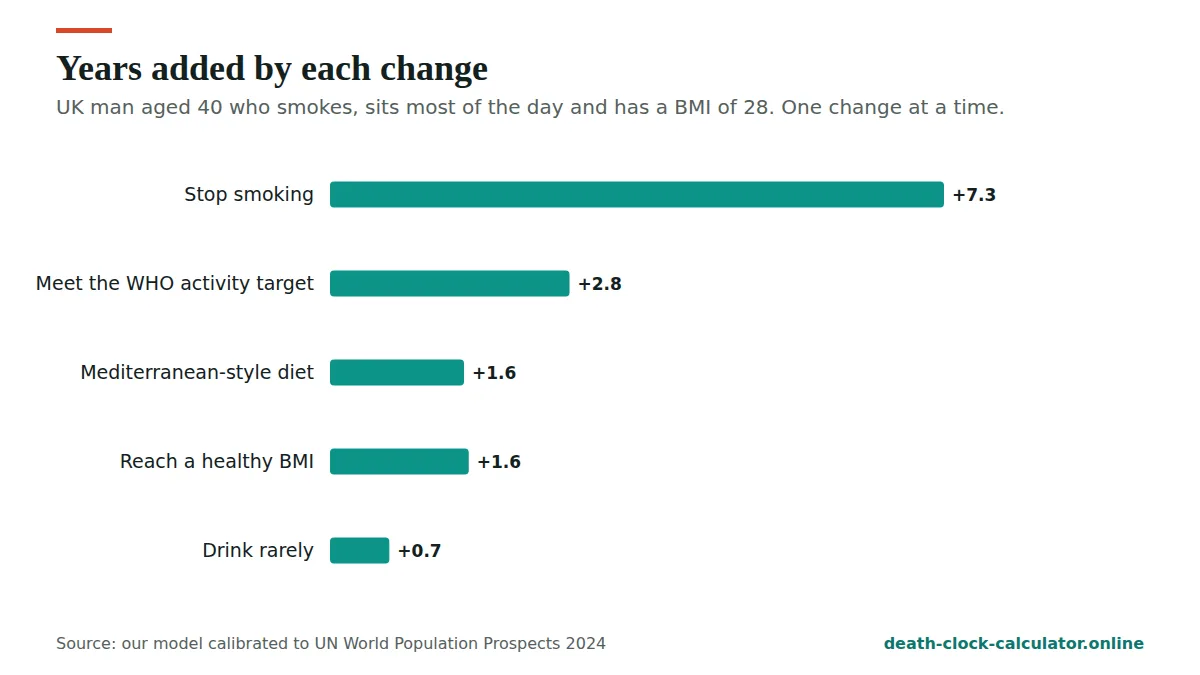
Partly. Healthy habits often go together, and their effects overlap, so you can’t simply add the numbers. Still, people who combine several healthy habits live many years longer on average than people with none. In our calculator, tick several changes in “What moves your estimate” to see a combined figure that allows for the overlap.
What doesn’t have strong evidence?
Many products promise a longer life. So far, no supplement, “longevity” drink or blood test has shown gains anywhere close to not smoking, moving and eating well in large, long studies. Be wary of anything that sells you a scary number and then a fix.
Where to start if you want to know how to live longer
You don’t have to change everything at once to learn how to live longer. Most people do better with one or two changes that last than with a long list that fades in a month. The best place to start is the habit with the biggest effect that you feel ready to work on.
This table shows how much each habit can move an estimate in our calculator, so you can see which steps matter most for how to live longer. We enter these habits as “effective age”: the number of years your risk behaves as if you were older (plus) or younger (minus).
| Habit | Least healthy answer | Healthiest answer | Spread |
|---|---|---|---|
| Smoking | +10.6 (smoked 30 years or more) | 0 (never smoked) | 10.6 |
| Alcohol | +5 (several drinks a day) | 0 (never or rarely) | 5 |
| Activity | +2.2 (mostly sitting) | −2.2 (above the WHO target) | 4.4 |
| Diet | +1.8 (mostly processed) | −1.4 (whole food and plants) | 3.2 |
| Outlook | +1.0 (often down or worried) | −1.0 (very hopeful) | 2.0 |
BMI is handled differently, with hazard ratios straight from the study, and is explained on BMI and life expectancy. The weights for diet and outlook are kept small on purpose, because the studies give a direction more than an exact number.
How to live longer by moving more
When people ask how to live longer, moving more is one of the easiest answers to act on. The activity figures are more encouraging than many people expect. In the pooled study of more than 650,000 adults, about 75 minutes of brisk walking a week was linked with 1.8 extra years. That works out to roughly 11 minutes a day.
The WHO target of 150 minutes a week is about 21 minutes a day. You don’t need a gym for any of it. Ideas that fit into a normal day:
- Walk briskly for part of your trip to work, school or the shops.
- Take the stairs when you can.
- Get off the bus a stop early.
- Garden, dance, cycle or play with children or grandchildren.
- Stand up and move for a few minutes every hour if you sit a lot.
- Add simple strength work twice a week, such as carrying shopping, rising from a chair without using your hands, or light weights.
If you have a health condition or haven’t been active for a long time, start gently and ask a doctor what suits you. When it comes to how to live longer through activity, something is better than nothing, and more is better than some.
How to live longer through food: small swaps that add up
The diet modelling study found the largest gains came from eating more legumes, whole grains and nuts, and less red and processed meat. Those are simple to act on, and none of them needs special products. For most people, food is where how to live longer turns into daily choices.
- Add beans, lentils or chickpeas to soups, curries, stews and salads a few times a week.
- Swap white bread, rice and pasta for whole grain versions, at least some of the time.
- Keep a handful of plain nuts as a snack instead of salty or sugary snacks.
- Make processed meat an occasional food rather than a daily one.
- Fill half the plate with vegetables and use olive oil for cooking and dressings, as in a Mediterranean-style diet.
Food is also about culture, family and pleasure. You don’t need to give up the dishes you love. Adjusting how often you eat them, and what goes alongside them, is enough to move in the right direction.
How to live longer at 40, 60 or 70
A common worry is that it’s too late to think about how to live longer. The evidence says otherwise. Quitting smoking at 60 still gained about 3 years in the British doctors study. The diet modelling study estimated about 8 extra years from a much better diet started at 60.
It also helps to know that your own expected age rises as you get older, because you have already passed earlier risks. In our model, a healthy American man who never smoked has an estimated average age at death of about 79.1 at age 40, and about 85.3 at age 70. These are averages for groups with a healthy BMI who never smoked, with wide ranges either side.
| Country | Men | Women |
|---|---|---|
| United States | 18.7 | 21.2 |
| United Kingdom | 19.0 | 21.3 |
| Canada | 20.0 | 22.8 |
| Australia | 20.3 | 22.9 |
| India | 14.8 | 16.1 |
| Pakistan | 12.8 | 14.7 |
So at 65, there are often two decades or more ahead. That is plenty of time for healthy habits to pay off, so how to live longer is a useful question at any age. More on how the numbers change with age is on life expectancy by age.
How to live longer with a long-term health condition
Many people already live with a condition such as high blood pressure, diabetes or heart disease. The same habits still help, and good care makes a big difference on top. For you, how to live longer starts with working closely with your care team.
- Take medicines as prescribed, and ask if anything is unclear or causing side effects.
- Keep your check-ups, even when you feel well.
- Know your own numbers, such as blood pressure, and what your targets are.
- Tell your doctor before making big changes to exercise or diet.
Our calculator can’t see illness, so if you have a condition, your real outlook depends much more on your care than on any average. A doctor who knows your history is the best guide.
Making healthy habits stick
Knowing how to live longer is the easy part. Doing it week after week is harder. These ideas help many people:
- Start small. A ten-minute walk you actually take beats an hour you plan and skip.
- Tie it to something you already do. Walk after lunch, or stretch while the kettle boils.
- Make the easy choice the healthy one. Keep fruit in view and snacks out of sight.
- Do it with someone. A friend, partner or group makes it more fun and more likely to last. It also builds the social ties linked with longer lives.
- Expect slips. A missed week is normal. Start again without guilt.
Myths about how to live longer
- “It’s too late for me.” Quitting smoking at 60 and better eating at 60 were both still linked with extra years.
- “I need a gym or a strict plan.” Brisk walking was enough for a clear gain in the activity study. Learning how to live longer doesn’t require special kit.
- “A drink a day is good for you.” The large global alcohol analysis found the lowest overall health harm at zero drinks.
- “My genes decide everything.” Genes matter, but how to live longer is not only up to them. The habits on this page made large differences in big studies.
Use the death clock to see how to live longer in your own numbers
Run the death clock calculator with your honest answers. Then open “What moves your estimate”. It shows the modelled change from each healthy step on its own, and from the ones you pick together, allowing for overlap.
Treat the numbers as a guide to how to live longer in your own case, not as a promise. Every result is an average for people like you, with a wide range. The full method is on how we calculate.
If thinking about lifespan makes you anxious, that is common. Our death anxiety help page has calm, practical steps. The aim of learning how to live longer is to enjoy the years ahead, not to worry about them.
Frequently asked questions
What is the best way to live longer?
Not smoking has the biggest proven effect: lifelong smoking costs about 10 years. After that, keeping a healthy weight, being active, eating mostly whole foods, drinking little alcohol and managing blood pressure all add years in large studies.
How many years does exercise add?
In a pooled study of more than 650,000 adults, about 75 minutes of brisk walking a week was linked with 1.8 extra years, and the most active group gained about 4.5 years compared with inactive people.
Is it too late to change at 60?
No. Quitting smoking at 60 gained about 3 years in a long British study, and a diet modelling study estimated about 8 extra years from a much better diet started at 60. Healthy changes help at any age.
Do supplements help you live longer?
No supplement has shown gains anywhere near those from not smoking, moving and eating well in large, long studies. Be wary of products that promise a longer life.
What should I change first to live longer?
The first step in how to live longer depends on you. If you smoke, stopping has the biggest proven effect: lifelong smoking cost about 10 years in the British doctors study. If you don’t smoke, moving more is often the easiest start, as 75 minutes of brisk walking a week was linked with 1.8 extra years.
How much walking do I need to live longer?
In a pooled study of more than 650,000 adults, about 75 minutes of brisk walking a week, roughly 11 minutes a day, was linked with 1.8 extra years. The WHO suggests 150 to 300 minutes of moderate activity a week for adults, plus muscle strengthening twice a week. Walking is one of the simplest answers to how to live longer.
What foods help you live longer?
In the diet modelling study, the biggest gains came from more legumes, whole grains and nuts, and less red and processed meat. A Mediterranean-style diet cut major heart events by about 30% in the PREDIMED trial. Small swaps you can keep up count more than a strict plan you drop. No single food is the answer to how to live longer.
Does friendship really help you live longer?
It seems to. A review of 148 studies found that people with stronger social relationships had 50% higher odds of survival. Time with friends, family and community is one of the more pleasant answers to how to live longer. A regular call, a shared meal or a local group all count.
Can the death clock show me how to live longer?
It can show which changes matter most in our model. Enter your answers in the death clock calculator and open “What moves your estimate”. The figures are averages for people like you, with wide ranges, not a promise. The method is on how we calculate.
If you are feeling low
If this topic is weighing on you, please talk to someone today. You do not need to be in crisis to call.
- United States: call or text 988 (988 Suicide and Crisis Lifeline)
- United Kingdom and Ireland: Samaritans, call 116 123 for free
- India: Tele-MANAS, call 14416 (free, 24 hours, government of India)
- Anywhere else: findahelpline.com lists free, confidential helplines by country
If you are in danger right now, call your local emergency number.
Sources
- Doll R, Peto R, et al. BMJ, 2004; 328: 1519. doi
- Global BMI Mortality Collaboration. The Lancet, 2016; 388: 776-786. doi
- Moore SC, et al. PLOS Medicine, 2012; 9(11): e1001335. doi
- Fadnes LT, et al. PLOS Medicine, 2022; 19(2): e1003889. doi
- Estruch R, et al. NEJM, 2018; 378: e34. doi
- GBD 2016 Alcohol Collaborators. The Lancet, 2018; 392: 1015-1035. doi
- Holt-Lunstad J, Smith TB, Layton JB. PLOS Medicine, 2010; 7(7): e1000316. doi
- World Health Organization. Guidelines on physical activity and sedentary behaviour, 2020. who.int
See your own estimate in 30 seconds
Free, private and based on UN 2024 data for 201 countries. Nothing you enter is stored.
Open the death clock →