
How Will I Die? The Most Common Causes for People Like You
No calculator can know how one person will die. What we can show is how people of your age, sex and country most often die, from World Health Organization statistics. For adults worldwide, heart disease and stroke are the leading causes, and many of the top causes are strongly linked to smoking, weight, blood pressure and activity.
- UN 2024 data, 201 countries
- Nothing stored or sent
- Free, no sign-up
Pick your country, age group and sex to see the five leading causes of death for that group. These are shares of all deaths in the group, not your personal odds. For when, rather than how, use the death clock calculator.
Choose a country to see the leading causes of death for that group.
Source: World Health Organization, Global Health Estimates 2021 (published 2024). Shares of all deaths in that group in 2021. Population statistics, not a prediction about you.
On this page
What are the most common causes of death in adults?
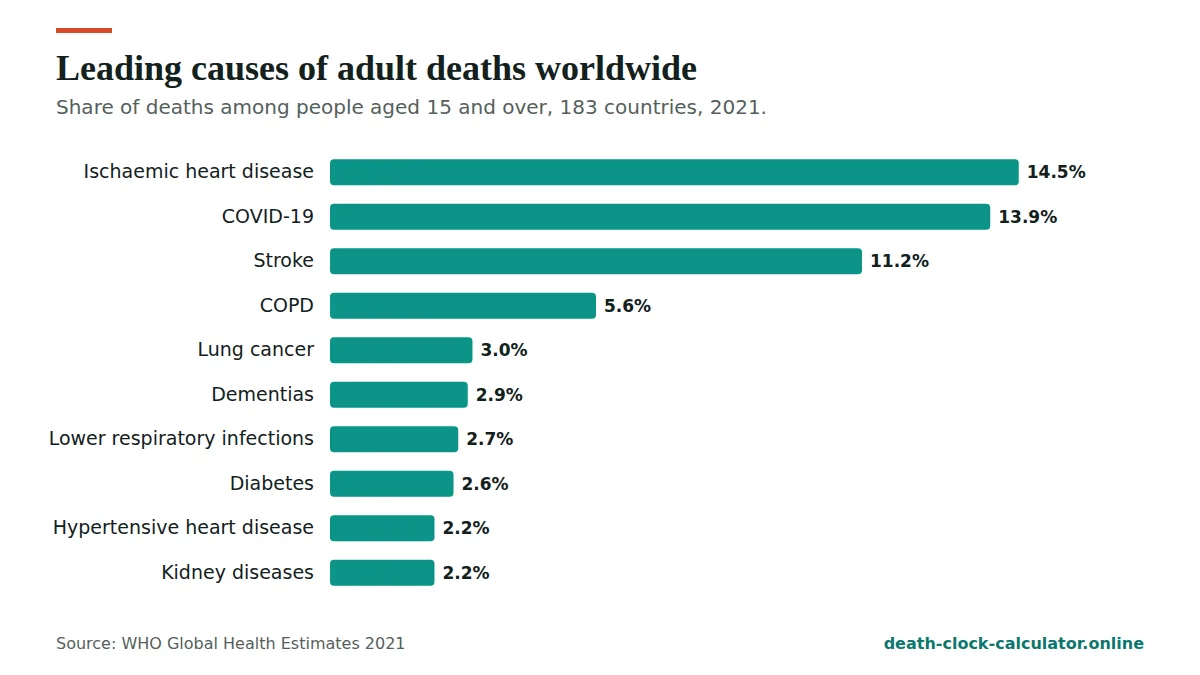
Across the 183 countries in WHO’s Global Health Estimates, these were the leading causes of death among people aged 15 and over in 2021:
| Rank | Cause | Share of adult deaths |
|---|---|---|
| 1 | Ischaemic heart disease (heart attacks and blocked heart arteries) | 14.5% |
| 2 | COVID-19 | 13.9% |
| 3 | Stroke | 11.2% |
| 4 | Chronic obstructive pulmonary disease (COPD) | 5.6% |
| 5 | Lung cancer (trachea, bronchus and lung) | 3.0% |
| 6 | Alzheimer disease and other dementias | 2.9% |
| 7 | Lower respiratory infections, such as pneumonia | 2.7% |
| 8 | Diabetes | 2.6% |
| 9 | Hypertensive heart disease (from high blood pressure) | 2.2% |
| 10 | Kidney diseases | 2.2% |
2021 was a pandemic year, which is why COVID-19 ranks so high. WHO’s 2021 estimates are the latest full set by country, age and sex. In later years COVID-19 deaths fell sharply in most countries, so heart disease and stroke are now even further ahead.
How will I die at different ages? Causes by age
The pattern changes a lot across a lifetime. Young adults mostly die from injuries. From middle age, chronic diseases take over.
| Age group | Men | Women |
|---|---|---|
| 15 to 29 | Road injury 16.0%, interpersonal violence 12.5%, self-harm 8.1% | Maternal conditions 15.2%, self-harm 7.4%, COVID-19 7.1% |
| 30 to 49 | COVID-19 16.9%, ischaemic heart disease 8.9%, road injury 7.1% | COVID-19 14.4%, ischaemic heart disease 6.2%, maternal conditions 6.0% |
| 50 to 69 | COVID-19 17.4%, ischaemic heart disease 14.5%, stroke 9.7% | COVID-19 14.0%, ischaemic heart disease 12.3%, stroke 10.9% |
| 70 and over | Ischaemic heart disease 16.3%, COVID-19 14.4%, stroke 12.8% | Ischaemic heart disease 17.5%, stroke 14.1%, COVID-19 11.3% |
Two things stand out. Among young men, road crashes and violence lead. Among young women worldwide, complications of pregnancy and childbirth are still the top cause, mostly in countries with weaker maternal care. After 50, heart disease and stroke dominate for everyone.
Causes of death at 50 to 69 in different countries
| Country | Men | Women |
|---|---|---|
| United States | Ischaemic heart disease 16.4%, COVID-19 15.5%, lung cancer 4.9% | COVID-19 15.7%, ischaemic heart disease 10.3%, lung cancer 6.3% |
| United Kingdom | Ischaemic heart disease 15.7%, COVID-19 8.7%, lung cancer 7.7% | Lung cancer 9.9%, breast cancer 8.2%, ischaemic heart disease 7.2% |
| Canada | Ischaemic heart disease 16.4%, lung cancer 8.8%, COVID-19 5.3% | Lung cancer 12.6%, breast cancer 8.1%, ischaemic heart disease 7.9% |
| India | COVID-19 29.7%, ischaemic heart disease 15.3%, COPD 6.3% | COVID-19 17.5%, ischaemic heart disease 14.0%, stroke 8.5% |
| Pakistan | Ischaemic heart disease 21.0%, COVID-19 13.2%, stroke 9.3% | Ischaemic heart disease 19.5%, stroke 11.7%, COVID-19 9.4% |
| Nigeria | Tuberculosis 11.5%, stroke 11.1%, ischaemic heart disease 10.9% | Tuberculosis 12.6%, ischaemic heart disease 10.8%, stroke 10.0% |
In the UK and Canada, cancers lead for women in this age group. In Pakistan, heart disease takes a larger share than in most countries. In Nigeria, tuberculosis is still a leading cause in middle age, a reminder that infections remain a major risk in many places.
How do causes of death differ by country?
A lot. In high-income countries, most deaths happen at older ages, from heart disease, stroke, dementia and cancers. In many lower-income countries, infections, maternal conditions and injuries still cause a larger share of deaths at younger ages. Use the tool above to compare your country with others. Our life expectancy by country page shows how these differences add up to gaps of 30 years or more.
How will I die? What lowers the risk of the top causes
Many of the leading causes share the same main risk factors. This is general public health information, not medical advice. Talk to a doctor about your own risks.
- Not smoking. Smoking raises the risk of heart disease, stroke, COPD and lung cancer. Quitting at any age helps. See smoking and life expectancy.
- Blood pressure. High blood pressure is a major cause of stroke and heart disease, and it often has no symptoms. A simple check is worth it.
- Weight and diabetes. A healthy BMI lowers the risk of diabetes, heart disease and some cancers. See what BMI means.
- Activity. Regular movement lowers heart and stroke risk.
- Alcohol. Less alcohol means lower risk of liver disease, several cancers and injuries.
- Road safety. Seat belts, helmets and not driving after drinking prevent many young deaths.
- Screening and vaccines. Many cancers and infections are far easier to treat or prevent when caught early.
You can see how several of these habits change your own estimate in the “What moves your estimate” panel of the death clock.
How am I going to die? Can a calculator tell me my cause of death?
No. A “cause of death calculator” that names one cause for you is guessing. Real causes depend on your health history, genes, environment and chance. What we show are population shares: out of all deaths in your group, how many came from each cause. That is useful for knowing which risks matter most at your age, and nothing more.
My death date and cause: why they need two different tools
Many people search for “my death date and cause” as if one tool could answer both. In fact they are two separate questions, and they rest on different data.
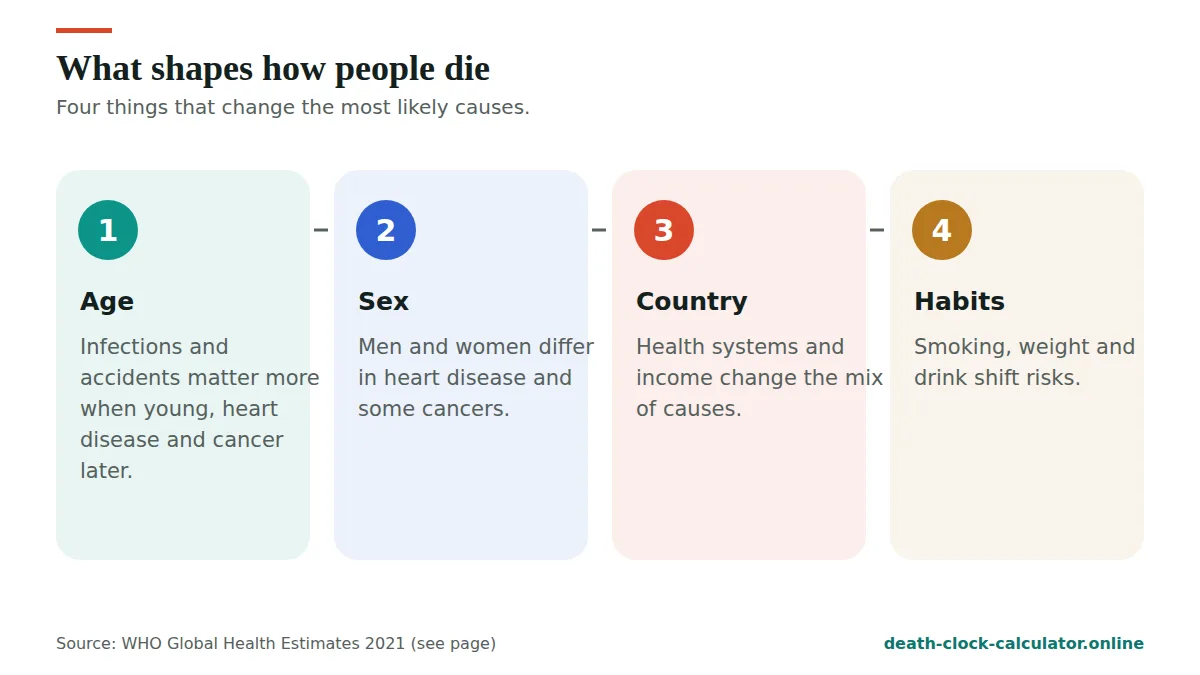
- When comes from life tables. These show how likely people are to die at each age in each country. Our death date calculator uses UN figures for this.
- How comes from cause of death statistics. The tool on this page uses WHO estimates of what share of deaths in each group came from each cause.
Put together, they give a rough answer to “my death date and cause”, not a plan. For example, a healthy 40-year-old American man who never smoked has an estimated average age at death of 79.1 in our model. Most deaths at that age and above come from heart disease and stroke, as the tables above show. Neither fact names a date or a cause for him.
Why no tool can answer “my death date and cause”
Both answers depend on things no website can see: your medical history, your genes, where you will live, and plain chance. A tool that promises “my death date and cause” in one result is inventing the precision. Treat any such result as entertainment, not information.
How am I gonna die? Reading the cause tool the right way
The tool near the top of this page is simple, but the numbers are easy to misread. If your real question is “how am I gonna die?”, here is how to use it well.
- Choose your country. Causes differ a lot between countries, so pick the one you live in.
- Choose your age group. Pick the group you are in now. Then look at the older groups too, since that is where most deaths happen.
- Choose your sex. Men and women have different leading causes, especially at younger ages.
- Read the shares. Each bar is the share of all deaths in that group, not your personal chance of dying from that cause.
- Look for the lifestyle label. Causes marked “linked to lifestyle” are ones where habits such as smoking, weight and alcohol play a large part.
A share tells you which risks matter most in your group. If heart disease is the largest bar, that is the area where checks and habits give the most return for people like you.
Share of deaths is not the same as your risk
In the adult table above, heart disease causes about one in seven deaths. That does not mean you have a one in seven chance of dying from it this year. It means that, among the people in that group who did die, about one in seven died of heart disease. Your yearly risk of dying at all is far smaller, especially when you are young. So a large bar does not answer “how will I die” for you. It shows where the risk sits for your group.
How will you die? Why age matters more than anything else
Ask “how will you die?” and the single biggest clue is when you are likely to die. Causes change sharply with age, so the age most people reach shapes which causes lead.
In the United States and the United Kingdom, most people who reach 40 in good health go on to reach 70. At those older ages, heart disease, stroke, lung disease, dementia and cancers lead. That is why, for most readers, these long-term conditions matter far more than the risks that make headlines.
| Group | Reach 70 | Reach 80 | Reach 90 |
|---|---|---|---|
| United States, men | 76% | 52% | 23% |
| United States, women | 84% | 64% | 34% |
| United Kingdom, men | 82% | 59% | 24% |
| United Kingdom, women | 87% | 68% | 35% |
| India, men | 63% | 35% | 10% |
| Pakistan, men | 51% | 24% | 5% |
Where fewer people reach old age, a larger share of deaths happens in middle age. That is where infections, injuries and, for women, pregnancy complications take a bigger place, as the country table above shows.
How am I going to die if I live where lives are shorter?
Life expectancy at birth varies by nearly 30 years between countries. That gap changes the answer to “how am I going to die” a great deal, because it changes the age at which most people die.
| Country | Men | Women |
|---|---|---|
| Australia | 82.1 | 85.7 |
| Canada | 80.4 | 84.8 |
| United Kingdom | 79.4 | 83.2 |
| United States | 76.9 | 81.8 |
| India | 70.5 | 73.6 |
| Pakistan | 65.3 | 70.2 |
| Nigeria | 54.2 | 54.7 |
A man born in Australia can expect to live about 28 years longer than a man born in Nigeria, based on these UN figures. Part of that gap comes from deaths in childhood and early adulthood, which are much rarer where health care, clean water and road safety are stronger.
Moving country is not the only thing that matters. Within any country, habits and access to care still shift the answer to “how will you die?” The death clock calculator shows how much for people like you.
How will I die? What you can check this year
An honest answer to “how will I die?” includes the risks you can do something about. You can’t control every risk, but several of the leading causes give early warning signs that simple checks can pick up. This is general information, not medical advice.
- Blood pressure. Often has no symptoms. Many pharmacies can check it quickly.
- Blood sugar. Ask a doctor whether a diabetes test makes sense for your age and weight.
- Cholesterol. A blood test can show whether heart risk is building up.
- Cancer screening. Ask which screening tests are offered where you live for your age and sex.
- Smoking. If you smoke, stopping is the single change with the largest effect in our model. See how to live longer for more.
See a doctor promptly for chest pain, sudden weakness on one side, trouble speaking, or breathlessness. These can be signs of heart attack or stroke, and fast care makes a real difference.
If thinking about how you will die feels heavy
Questions like “how will I die” or “how am I going to die” often come up late at night or after a loss. Wanting to know is normal. If the thought keeps coming back or makes daily life hard, our death anxiety help page has calm, practical steps. Talking with someone you trust helps too.
How will I die? Three common mistakes when thinking about it
When people ask “how will I die?”, they often picture the risks they hear about most. The data tells a quieter story. Here are three common mistakes, and what the WHO figures on this page show instead.
- Thinking rare, dramatic causes are the most likely. For adults, heart disease and stroke lead by a wide margin. Slow, long-term conditions cause far more deaths than the events that make the news.
- Thinking a calculator can name your cause. It can’t. The best any tool can do is show the share of deaths from each cause in a group like yours.
- Thinking nothing can be done. Many of the top causes share the same risk factors: smoking, blood pressure, weight, activity and alcohol. Those can change at any age.
So the fair answer to “how am I going to die?” is this: most likely from a long-term condition late in life, with habits and health checks shifting the odds. For your own average age and range, use the death clock calculator, or try the when will I die quiz for a quicker version.
Frequently asked questions
How will I die?
No one can know how one person will die. What statistics show is the most common causes for people of your age, sex and country. For adults worldwide, heart disease and stroke lead, and many top causes are linked to smoking, weight, blood pressure and activity.
What will be my cause of death?
No test or calculator can name it. Tools that give one cause are guessing. The tool on this page shows the share of deaths from each leading cause in your group, from WHO data, which tells you which risks matter most at your age.
What is the most common cause of death?
Worldwide, ischaemic heart disease is the leading cause of death in adults, followed by stroke. In WHO’s 2021 estimates, COVID-19 was also near the top because of the pandemic.
What is the most common cause of death for young people?
For young men aged 15 to 29 worldwide, road injuries lead, followed by violence and self-harm. For young women, complications of pregnancy and childbirth lead worldwide, mostly in countries with weaker maternal care.
Can I find my death date and cause?
For “when”, our death clock gives an average age and range for people like you. For “how”, the tool on this page shows common causes for your group. Neither can predict your own future, but both show which habits matter.
How am I gonna die, according to statistics?
Statistics can’t answer “how am I gonna die” for one person. They show what most often causes death in groups like yours. For adults worldwide, ischaemic heart disease and stroke lead. Use the tool on this page to see the top five causes for your country, age group and sex, from WHO Global Health Estimates 2021.
How will you die if you reach old age?
No one can say for one person. For people aged 70 and over worldwide, WHO data for 2021 shows ischaemic heart disease as the top cause, followed by stroke and COVID-19, which was high because of the pandemic. Lung disease, dementia and cancers are also common at these ages.
Why is COVID-19 so high in the cause of death tables?
The tables use WHO’s 2021 estimates, the latest full set by country, age and sex. 2021 was a pandemic year, so COVID-19 ranks near the top in many groups. In later years its deaths fell sharply in most countries, which leaves heart disease and stroke even further ahead.
How will I die if I smoke?
No one can say for one person, but smoking changes the likely causes and the timing. Smoking raises the risk of heart disease, stroke, COPD and lung cancer, which are all among the leading causes. In our model, lifelong smoking lowers the estimate by about 10 years. See smoking and life expectancy for what quitting at each age can do.
Can a quiz tell me how I will die?
No quiz can answer “how will I die” for one person. A quiz can give a rough average for how long people like you live, as our when will I die quiz does. For how, the honest answer is the share of deaths from each cause in your group, which is what the tool on this page shows.
If you are feeling low
If this topic is weighing on you, please talk to someone today. You do not need to be in crisis to call.
- United States: call or text 988 (988 Suicide and Crisis Lifeline)
- United Kingdom and Ireland: Samaritans, call 116 123 for free
- India: Tele-MANAS, call 14416 (free, 24 hours, government of India)
- Anywhere else: findahelpline.com lists free, confidential helplines by country
If you are in danger right now, call your local emergency number.
Source
World Health Organization. Global Health Estimates 2021: deaths by cause, age, sex, by country and by region, 2000-2021. Geneva: WHO; 2024. who.int/data/gho
For when rather than how, go to the death clock calculator or check the accuracy of death clocks.
See your own estimate in 30 seconds
Free, private and based on UN 2024 data for 201 countries. Nothing you enter is stored.
Open the death clock →