
World Death Clock: How Many People Die Every Second?
About 2 people die every second worldwide. That is roughly 7,300 an hour, 174,000 a day and 63.6 million a year, based on the UN’s estimate for 2026. In the same second, about 4 babies are born, so the world’s population is still growing.
- UN 2024 data, 201 countries
- Nothing stored or sent
- Free, no sign-up
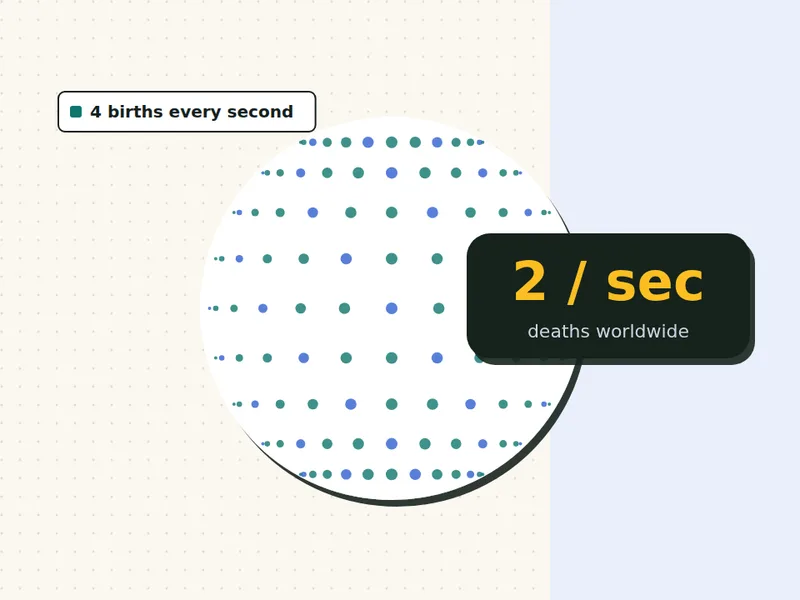
Computed from the UN World Population Prospects 2024 estimate for 2026 (about 63.6 million deaths and 132.5 million births in the year). Not a live feed.
This world death clock is worked out from a yearly UN estimate, not from a live feed. No one records every death in the world in real time. For your own life expectancy, use the death clock calculator.
On this page
How the world death clock is worked out
We start from one number: the UN World Population Prospects 2024 estimate of deaths worldwide in 2026, which is about 63,637,000. Then we spread it evenly over the year:
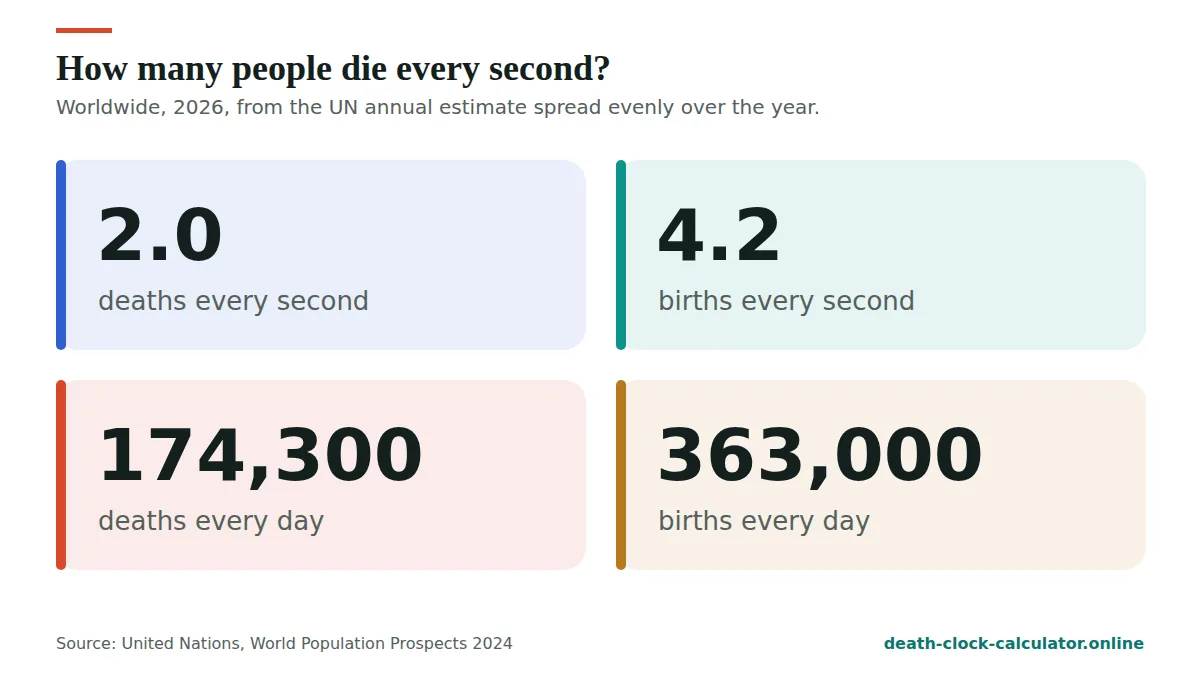
| Per | Deaths | Births |
|---|---|---|
| Year | 63,637,000 | 132,503,000 |
| Day (÷ 365) | 174,300 | 363,000 |
| Hour (÷ 24) | 7,260 | 15,130 |
| Minute (÷ 60) | 121 | 252 |
| Second (÷ 60) | 2.0 | 4.2 |
The counters above multiply these rates by the time since midnight and since 1 January on your device’s clock. Real deaths are not perfectly even. There are more in winter in many countries and during epidemics, but over a year the average holds.
World death clock by region: where do most deaths happen?
Most deaths happen where most people live. Asia has about 59% of the world’s people and about 55% of its deaths. Europe has about 9% of the world’s people but more than 13% of deaths, because its population is older. Africa has about 19% of people and a similar share of deaths: its population is young, but death rates at each age are higher.
| Region | Deaths in 2026 | Share of world deaths | Life expectancy at birth |
|---|---|---|---|
| Asia | 34,879,246 | 54.8% | 75.4 |
| Africa | 11,885,985 | 18.7% | 64.4 |
| Europe | 8,497,271 | 13.4% | 79.6 |
| Latin America and the Caribbean | 4,581,644 | 7.2% | 76.2 |
| Northern America | 3,468,873 | 5.5% | 80.1 |
| Oceania | 324,283 | 0.5% | 79.6 |
| World | 63,637,314 | 100% | 73.8 |
Why is the world population still growing?
Because more people are born than die. Each second, about 4 babies are born and about 2 people die. That adds roughly 190,000 people a day. Growth is slowing as families get smaller, and the UN expects world population to peak later this century.
How many days until we all die?
There is no such date. Humanity is not on a countdown. People die and are born every day, and the total keeps growing. If this question comes from worry about the future, you’re not alone, and it can help to talk it through with someone you trust.
For a personal estimate, the death countdown shows how many days people like you have on average, and life expectancy by country compares the whole world.
How many people die in a second, a minute and a week?
The short answer to “how many people die in a second?” is about 2. That figure comes from dividing the UN estimate for 2026, about 63.6 million deaths, by the number of seconds in a year. The same sum works for any unit of time.
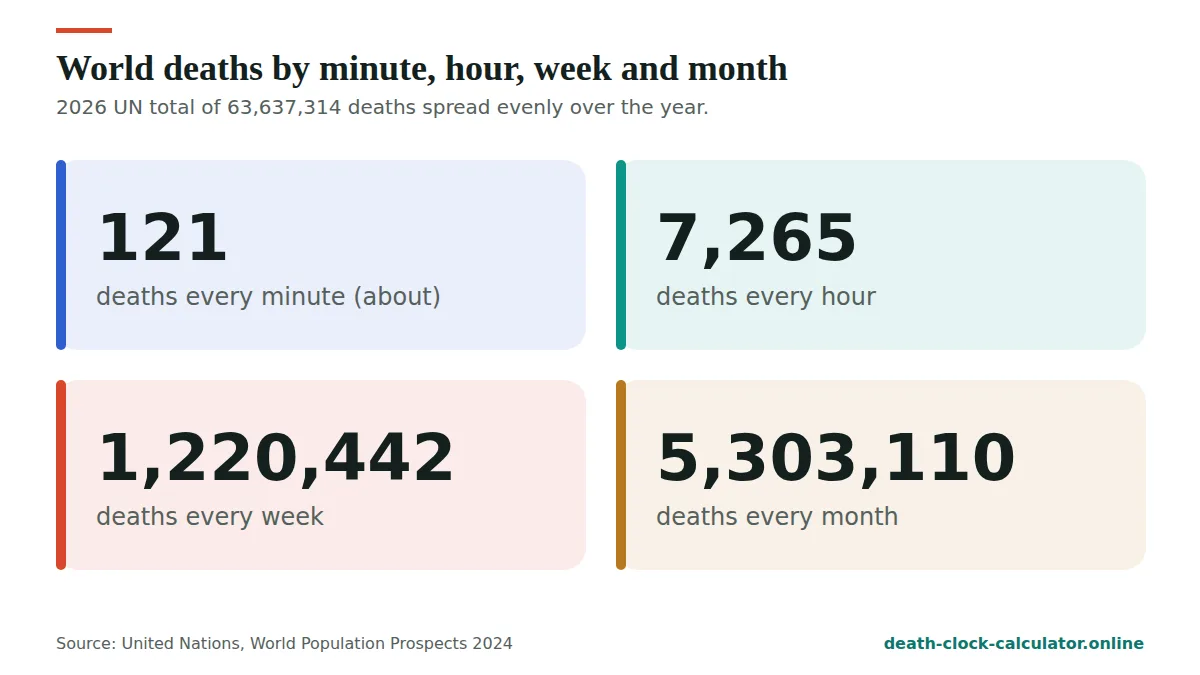
| Time | Deaths | Births |
|---|---|---|
| 1 second | 2.0 | 4.2 |
| 1 minute | 121 | 252 |
| 1 hour | 7,265 | 15,126 |
| 1 day | 174,349 | 363,023 |
| 1 week | 1,220,442 | 2,541,162 |
| 1 month | 5,303,110 | 11,041,956 |
| 1 year | 63,637,314 | 132,503,469 |
Put another way, one death happens somewhere in the world about every half second on average. One birth happens about every quarter of a second. These are averages over a whole year, so the real gaps between events are never this regular.
Why we round to “about 2” per second
The exact result of the sum is 2.02 deaths per second. Showing it to two decimal places would suggest a precision the data doesn’t have. The UN figure is itself an estimate, built from national records, surveys and models. So “about 2 people die in a second” is the fair way to say it.
Check the sum yourself
You don’t need to trust our counters. You can work out how many people die in a second with a phone calculator in under a minute:
- Take the UN estimate of world deaths in 2026: 63,637,314.
- Work out the seconds in a year: 365 days × 24 hours × 60 minutes × 60 seconds = 31,536,000.
- Divide the first number by the second. The answer is 2.02.
- Do the same with the 132,503,469 births. The answer is 4.20.
Divide by 365 instead and you get the daily figures. Divide by 8,760 (the hours in a year) for the hourly ones. Every number on this page is built this way, from two UN totals.
Births and deaths on the world death clock, side by side
The world death clock only tells half the story if you look at deaths alone. Births run at about twice the pace. Using the same UN figures for 2026, there are about 2.1 births for every death.
| Time | Births minus deaths |
|---|---|
| 1 second | About 2.2 |
| 1 minute | About 131 |
| 1 hour | About 7,861 |
| 1 day | About 188,674 |
| 1 year | About 68.9 million |
That daily figure of about 189,000 is where the “roughly 190,000 a day” above comes from. Over 2026 as a whole, the world gains close to 69 million people after deaths are counted. This does not include people moving between countries, because for the world as a whole those moves cancel out.
The death clock of the world in everyday terms
Big yearly totals are hard to picture. Smaller slices of time can make the death clock of the world easier to grasp. All of these come from the same UN yearly estimate for 2026, spread evenly.
- While you read one short paragraph (about 30 seconds): around 60 deaths and 126 births.
- In five minutes on this page: around 605 deaths and 1,260 births.
- In ten minutes: around 1,211 deaths and 2,521 births.
- In one hour: around 7,265 deaths and 15,126 births.
- In one week: around 1.2 million deaths and 2.5 million births.
These numbers can feel heavy at first. Keep in mind that the world has billions of people, and most deaths happen in old age after a long life. The counters show scale, not a trend toward disaster.
How the world death clock counters on this page work
There are four counters at the top of this page. Here is what each one does:
- Deaths worldwide today multiplies the deaths per second by the seconds since midnight on your device.
- Deaths worldwide this year does the same from 1 January.
- Births worldwide today uses the births per second, from midnight.
- Births worldwide this year uses the births per second, from 1 January.
Because the counters use your device’s clock and time zone, two people in different countries will see different “today” totals at the same moment. That is expected. Neither is wrong; each starts from its own local midnight.
Why the world death clock uses figures for 2026
The counters use the UN estimate for the current year, 2026, rather than an older count. Older totals would be firmer, but they would describe a smaller world with a different age mix. For a world death clock that runs in real time, the estimate for this year is the closer match.
When the calendar moves on, the right figures change too. A new year brings a new UN estimate, and the answer to how many people die in a second can shift a little. Small changes like this are normal from one year to the next, and they don’t change the overall picture of births running ahead of deaths. We update this world death clock when we move to a newer year.
Why a world death clock is an estimate, not a live count
A world death clock can look like a live feed from every hospital and home on Earth. It isn’t, and no such feed exists. Here is why every world death clock, including ours, is an estimate:
- Not every death is recorded quickly. In many countries, deaths are registered days, weeks or months later. In some places many deaths are never formally registered at all.
- The UN fills the gaps with models. World Population Prospects combines censuses, surveys and registration data into one consistent set of estimates.
- The yearly figure is a projection. The 2026 number was published in 2024, so it is a forecast for the year, not a total counted afterwards.
- Real deaths are uneven. They rise in winter in many countries and during epidemics. The counters spread the year evenly.
So the counters are good at showing the size and pace of deaths and births across the world. They can’t show what is happening in any one place right now.
How many days until we all die in the world? Why the question has no answer
People sometimes search “how many days until we all die in the world” after reading worrying news. The UN figures give a clear, calm reply: the world is not counting down. More people are born every day than die, so the total keeps rising.
A countdown needs a fixed end point. For one person, a death clock can estimate an average end point for people like them. For the world, the numbers point the other way. In 2026 the UN expects about 132.5 million births and about 63.6 million deaths. That is growth, not a countdown.
So the honest answer to “how many days until we all die?” is that there is no such number in any population data. Individual lives end. Humanity carries on, with new people born every second.
If the question comes from worry
Big numbers about death can stir up fear, especially late at night or after a loss. That reaction is common and it usually passes. If thoughts like this keep coming back, our death anxiety help page has simple steps that many people find useful. Talking to someone you trust helps too.
What the world death clock cannot tell you
A world death clock is good at one thing: showing the scale and pace of deaths and births across the planet. It is not built to answer other questions, and it is worth knowing where its limits are.
- Where deaths happen. The counters show one world total. They don’t split it by country or city.
- Why people die. The counters carry no cause of death. For common causes by age, sex and country, see how will I die.
- At what age. A death at 95 and a death in infancy each add one to the counter. The total hides the very different stories behind it.
- What happens next year. The rates are for 2026 only. Future years will have their own UN estimates.
- Anything about you. No world figure can say how long one person will live.
Keeping these limits in mind stops the numbers from feeling bigger or scarier than they are. They are a count of how many, nothing more.
From the death clock of the world to your own estimate
The world totals say nothing about any one person. For that, you need figures for your own country, age and sex. Life expectancy at birth ranges widely between countries, and our life expectancy by country page lists them all from the same UN source.
For a personal view, these tools use the same UN data as this page:
- The death clock calculator gives the average age at death for people like you, with a range.
- The death countdown turns that average into days, hours and minutes.
- The what age will I die page shows your chances of reaching 70, 80, 90 and 100.
Each one gives averages for groups, never a fixed date for you.
Frequently asked questions
How many people die in a second?
About 2 people die every second worldwide, based on the UN estimate of about 63.6 million deaths in 2026. In the same second, about 4 babies are born.
How many people die every day?
About 174,000 people die every day worldwide, and about 363,000 babies are born, based on UN World Population Prospects 2024 figures for 2026.
How many people die each year?
About 63.6 million people are expected to die worldwide in 2026, according to the UN’s World Population Prospects 2024 medium variant.
Is the world death clock live?
No one tracks every death in the world in real time. Our counters take the UN’s yearly estimate and spread it evenly over the year, based on the time on your device. It is labelled that way.
How many days until we all die?
There is no such date. People are born and die every day, and births still outnumber deaths by about 190,000 a day. The world’s population is still growing.
How many people die in a minute?
About 121 people die every minute worldwide, and about 252 babies are born. We get these figures by spreading the UN World Population Prospects 2024 estimate for 2026 evenly over the 525,600 minutes in a year. Real deaths are not perfectly even, so treat this as an average for the year.
How many people die in a week?
About 1.2 million people die worldwide in an average week, and about 2.5 million babies are born. These figures come from dividing the UN’s 2026 estimates of about 63.6 million deaths and 132.5 million births by the number of weeks in a year. Weeks in winter or during epidemics can be higher.
Why does the world death clock show a different total for my friend abroad?
The “today” counters start at midnight on each person’s own device, in their own time zone. Someone in a country where the day started earlier will see a larger total at the same moment. Both are correct. The yearly counters also depend on the date and time set on each device.
Where do the world death clock figures come from?
All figures come from the UN’s World Population Prospects 2024, medium variant, which estimates about 63,637,314 deaths and 132,503,469 births worldwide in 2026. We only divide these totals by units of time. No figures come from news reports, social media or live data feeds, because no live worldwide count of deaths exists.
Are more people born than die every second?
Yes. On the UN figures for 2026, about 4.2 babies are born every second and about 2 people die. That leaves the world with roughly 2.2 more people each second, or close to 189,000 a day. Births still clearly lead.
If you are feeling low
If this topic is weighing on you, please talk to someone today. You do not need to be in crisis to call.
- United States: call or text 988 (988 Suicide and Crisis Lifeline)
- United Kingdom and Ireland: Samaritans, call 116 123 for free
- India: Tele-MANAS, call 14416 (free, 24 hours, government of India)
- Anywhere else: findahelpline.com lists free, confidential helplines by country
If you are in danger right now, call your local emergency number.
Source
United Nations, Department of Economic and Social Affairs, Population Division (2024). World Population Prospects 2024, medium variant: demographic indicators. population.un.org/wpp
See your own estimate in 30 seconds
Free, private and based on UN 2024 data for 201 countries. Nothing you enter is stored.
Open the death clock →