
Death Date Calculator
Enter your date of birth, sex and country to see your projected death date as a month and year. It is the date when people like you reach their average age at death, based on 2024 UN life tables. For the full version with every lifestyle input, use our death clock calculator.
- UN 2024 data, 201 countries
- Nothing stored or sent
- Free, no sign-up
Middle half: 77 to 93. We never show a day or time.
On this page
How does a death date calculator work?
Think of it as a lifespan calculator by date of birth. It makes a life span prediction for people like you, then turns it into a date.
It turns your date of birth into your age today, then asks one question: on average, how many more years do people of this age, sex and country live? It adds those years to today’s date. The result is your projected death date.
Three things set it:
- Your date of birth tells the calculator your exact age today. This is called your attained age.
- Your sex picks the men’s or women’s survival curve.
- Your country sets how long people there live, from UN World Population Prospects 2024.
Everything else, like BMI and smoking, is optional here. Open “Improve accuracy” to add them. Each one moves your date a little earlier or later.
What year will I die, based on my date of birth?
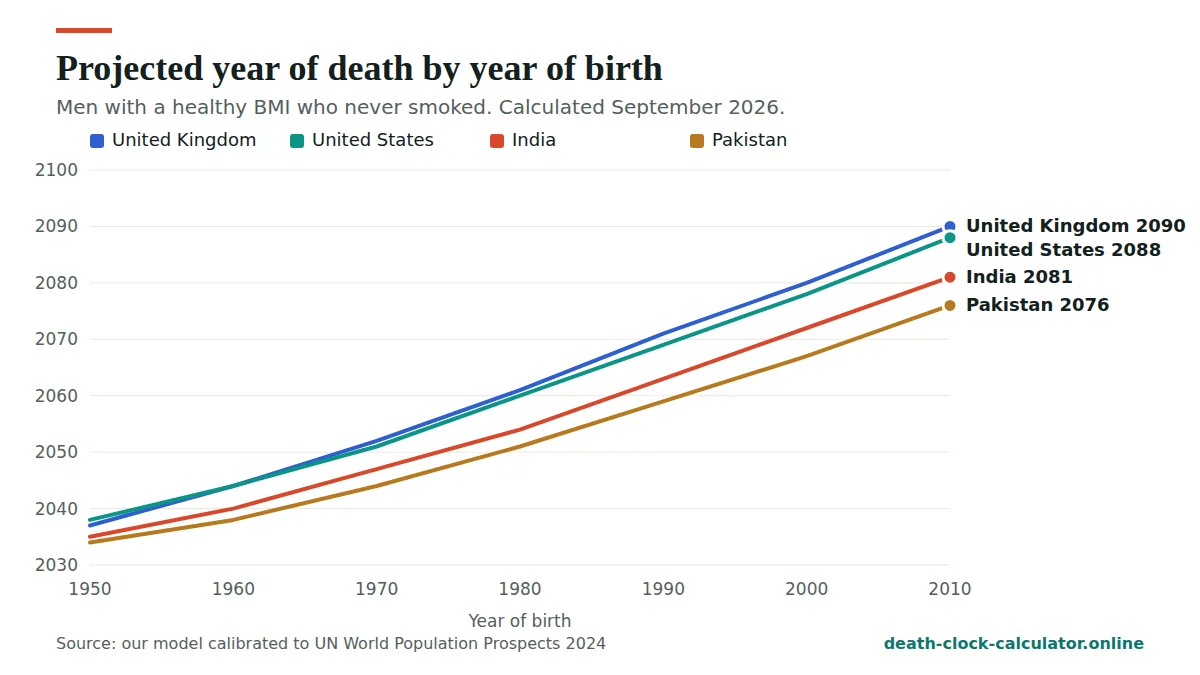
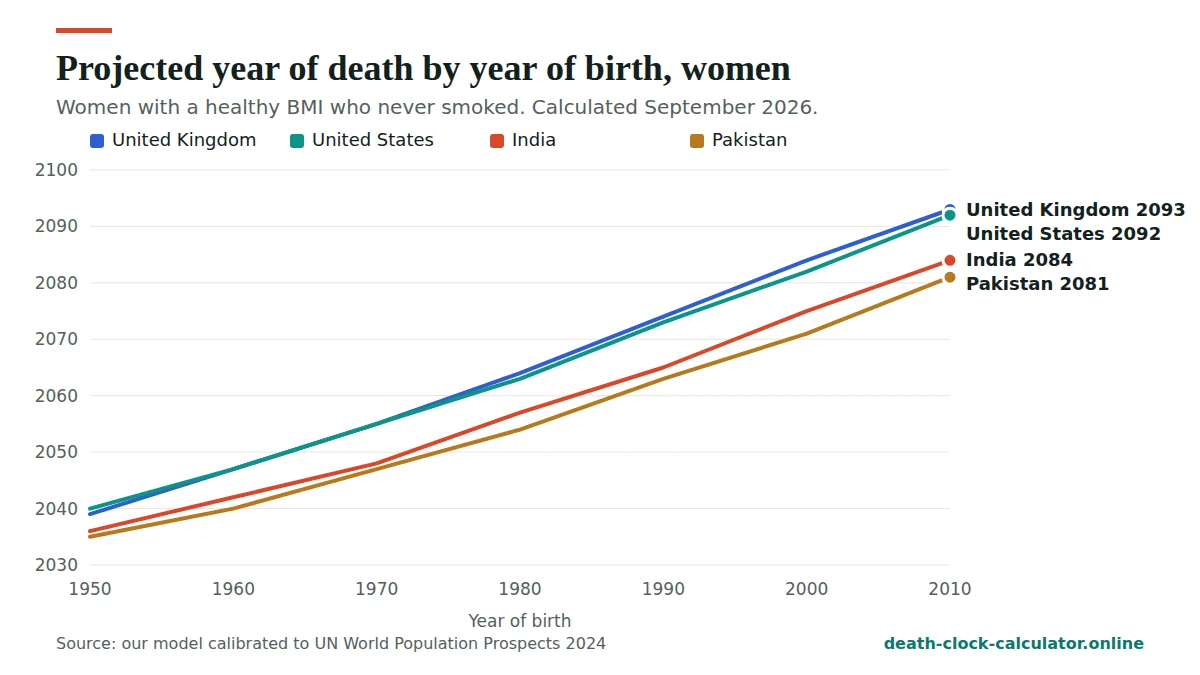
Here is what the model gives for healthy non-smokers born in different years, run in September 2026. Find your birth year and country for a rough answer, then use the calculator above for your own.
| Born in | United States | United Kingdom | India | Pakistan |
|---|---|---|---|---|
| 1950 | 2038 | 2037 | 2035 | 2034 |
| 1955 | 2041 | 2041 | 2037 | 2036 |
| 1960 | 2044 | 2044 | 2040 | 2038 |
| 1965 | 2048 | 2048 | 2043 | 2041 |
| 1970 | 2051 | 2052 | 2047 | 2044 |
| 1975 | 2056 | 2057 | 2050 | 2047 |
| 1980 | 2060 | 2061 | 2054 | 2051 |
| 1985 | 2064 | 2066 | 2059 | 2055 |
| 1990 | 2069 | 2071 | 2063 | 2059 |
| 1995 | 2073 | 2075 | 2067 | 2063 |
| 2000 | 2078 | 2080 | 2072 | 2067 |
| 2005 | 2083 | 2085 | 2077 | 2072 |
| 2010 | 2088 | 2090 | 2081 | 2076 |
| Born in | United States | United Kingdom | India | Pakistan |
|---|---|---|---|---|
| 1950 | 2040 | 2039 | 2036 | 2035 |
| 1955 | 2043 | 2043 | 2039 | 2038 |
| 1960 | 2047 | 2047 | 2042 | 2040 |
| 1965 | 2050 | 2051 | 2045 | 2043 |
| 1970 | 2055 | 2055 | 2048 | 2047 |
| 1975 | 2059 | 2060 | 2052 | 2050 |
| 1980 | 2063 | 2064 | 2057 | 2054 |
| 1985 | 2068 | 2069 | 2061 | 2058 |
| 1990 | 2073 | 2074 | 2065 | 2063 |
| 1995 | 2078 | 2079 | 2070 | 2067 |
| 2000 | 2082 | 2084 | 2075 | 2071 |
| 2005 | 2087 | 2089 | 2079 | 2076 |
| 2010 | 2092 | 2093 | 2084 | 2081 |
Notice two things. First, older people get a projected year that is closer, but at an older age. Second, the year for younger people is further away than you might expect, because it is based on today’s death rates. If health keeps improving, people born recently will likely live even longer than these tables show.
Is a death date the same as life expectancy?
Not quite. Life expectancy is usually quoted at birth: how long a newborn would live on average. Your death date starts from your age today instead, which is why it is usually later than your country’s headline number. A 60-year-old woman in the UK, for example, has an expected age at death of about 86 in our model, while life expectancy at birth for UK women is about 83.
The death date is also a point in time, not a number of years. That makes it easier to picture. Knowing that the average for people like you falls in, say, the 2070s can feel more concrete than “82.4 years”.
How much does my country change my death date?
A lot. Two people born on the same day, with the same habits, can get dates more than 20 years apart just because they live in different countries. For men born in 1990 in our table above, the gap between the United Kingdom and Pakistan is about 12 years. Healthcare, income, clean water, road safety and smoking rates all feed into this. If you have moved countries, choose the one where you have spent most of your adult life, or try both and compare.
Why does my death date move later as I get older?
Every year you live, you pass some of the risks that pulled the average down. So if you check again in five years with the same answers, your projected date will usually be a little later. This is not the calculator changing its mind. It is the effect of survivorship, and it is one of the most important ideas in life tables. Our life expectancy by age page shows it at every age.
Why does the death date show a month, not a day or time?
Because a day or an exact time of death would be false. Half of the people who share your answers die within a window that is often 14 to 18 years wide. Printing “Tuesday, 14 March 2071 at 3:12 pm” would look precise but mean nothing.
So we show the month and year of the average, and next to it the middle half: the range of years in which the middle 50% of people like you die. That range is the honest part of the answer. Some “death time” or “time of death calculator” tools print an hour. Treat those as entertainment.
Can a death date calculator be exact?
No death date calculator can be exact. It can be a good estimate for a group and a rough guide for you. Your genes, health history, habits, where you live and plain luck all matter, and no online form can see them. Our guide is the death clock real? explains what these numbers can and can’t tell you.
How can I push my death date later?
A death date calculator is most useful as a way to see which habits matter.
Open the optional questions in the calculator. After your result, the “What moves your estimate” panel shows which changes would add the most years for you. For most people, the biggest ones are:
- Stopping smoking. Quitting before 40 wins back most of the roughly 10 years that smoking takes.
- Moving towards a BMI of 20 to 25.
- Getting to about 150 minutes of moderate exercise a week.
You can see the same idea as a live timer on our death countdown, or as an age with odds on what age will I die.
Looking for the date someone died?
This page estimates a future date. If you are trying to find when a real person died, check official death records, a national death index, cemetery records or an obituary search. For family history, this tool works out age at death from two dates:
Age at death from two dates
For family history and records. Enter a birth date and a date of death.
Death calendar for Canada and Australia
The tables higher up cover the United States, the United Kingdom, India and Pakistan. Readers in Canada and Australia often ask for their own figures, so here they are. Both countries sit near the top of the UN list for life expectancy, so their projected years come a little later.
| Born in | Canada, men | Canada, women | Australia, men | Australia, women |
|---|---|---|---|---|
| 1950 | 2038 | 2040 | 2038 | 2040 |
| 1960 | 2045 | 2048 | 2046 | 2048 |
| 1970 | 2053 | 2057 | 2054 | 2057 |
| 1980 | 2062 | 2066 | 2064 | 2067 |
| 1990 | 2072 | 2076 | 2073 | 2076 |
| 2000 | 2081 | 2085 | 2083 | 2086 |
| 2010 | 2091 | 2095 | 2093 | 2096 |
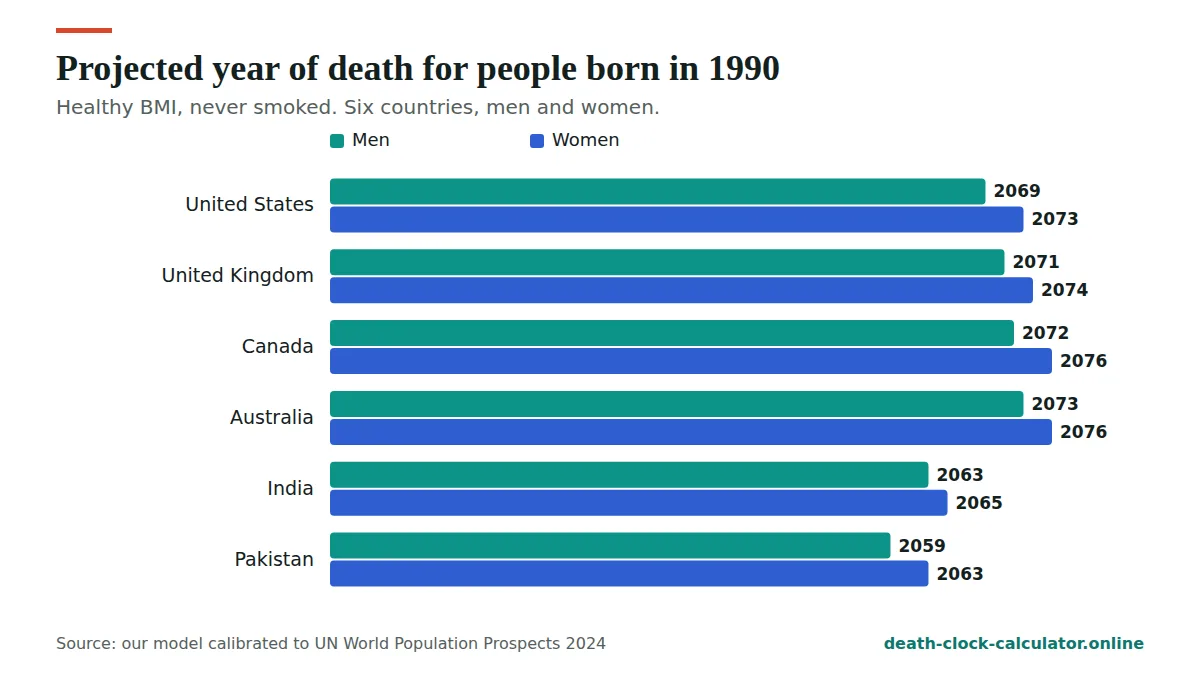
Compare the 1990 row with the men’s table further up. A healthy man born in 1990 gets 2069 in the United States, 2072 in Canada and 2073 in Australia. Same birthday, same habits, and the projected year still moves by four years. For more on each country, see life expectancy in Canada and life expectancy in Australia.
These are group averages for people with a healthy BMI who never smoked. Your own year can land well before or well after the one in the table.
Why men and women get different years
Pick any birth year in the tables and read across. The projected year for women is always later than for men. For people born in 1990, the gap looks like this:
- United States: 2069 for men and 2073 for women, a gap of 4 years.
- United Kingdom: 2071 and 2074, a gap of 3 years.
- India: 2063 and 2065, a gap of 2 years.
- Pakistan: 2059 and 2063, a gap of 4 years.
- Canada: 2072 and 2076. Australia: 2073 and 2076.
These gaps follow the gaps in life expectancy at birth. Across 201 countries and territories, women outlive men by 5.2 years on average (UN World Population Prospects 2024, 2023 estimates). The gap is widest in Ukraine at 13.3 years and narrowest in Togo at 0.4 years. When you choose your sex, the calculator simply switches to the matching survival curve.
How to plan with a date of death estimate
Some people use the result for practical planning: how long savings need to last, when to write a will, or when to talk with family about their wishes. The projected date can help here, but only if you read it the right way.
The projected month is the middle of the story, not the end. Half of the people with your answers live past it. A plan built to run out in that month would fall short for half of them.
- Plan to the late end of the range. Look at the middle half strip on your result and use its last year, not the headline year.
- Leave room beyond that. A quarter of people live past even the middle half. If your strip ends in a given year, one person in four with your answers is still alive after it.
- Don’t wait for the date to act. A will, a health check or a long-delayed trip is worth doing whatever year the calculator shows.
For money questions, speak to a qualified adviser. They can work with your real pension, savings and health details, which no online form can see.
Why two calculators can give you different dates
If you try a few tools, you may get years that differ by a decade or more. That does not mean one of them is broken. It usually comes down to four choices:
- Starting point. Some tools add life expectancy at birth to your birth date. That ignores the years you have already survived, and it gives older people a date that is too early. Ours starts from your age today.
- Data year. Death rates change over time. We use UN World Population Prospects 2024, with estimates for 2023. Older data usually gives earlier years.
- Which answers count. Each extra question, such as BMI or smoking, can move the year. A tool with fewer questions shows the average for a wider group.
- Randomness. Some sites add a random number or pick a date for fun. Ours gives the same result every time for the same answers.
Here is the first point in numbers. A healthy 70-year-old American man has 15.3 years left in our model, which points to an age of about 85. A tool that used life expectancy at birth (76.9 years for US men) would put his date only about 7 years away. The difference is survivorship, and it matters most for older users.
What about a death time?
Some tools add an hour and minute to the result. Two of them can then disagree by hours as well as by years, and neither hour means anything. Death rates are measured per year of age. We round to a month only so the result is easy to read. To see each step of our model, visit the method page.
Using the death date calculator for someone else
People often run the numbers for a parent or partner. That is fine, with two cautions.
First, enter their real date of birth, sex and country, and leave the optional questions blank unless you know the answers. A guess about someone else’s weight or habits can move the result by years. In our model, the BMI band alone can shift the estimate for a 40-year-old in the United Kingdom by up to about 9.6 years.
Second, think before you share the result. A projected year can land hard, especially for an older relative. For a healthy 80-year-old woman in the UK, our model gives about 10.6 more years on average. Many will live longer than that, but a date about ten years away can still feel close.
If the number upsets you or them, that is a common reaction. Our page on coping with death anxiety has calm, practical steps.
Death date calculator: a quick recap
The death date calculator gives a month and a year, never a day or an hour. That death date is the average for people with your answers. Treat the date of death it shows as a middle point in a wide range, and use it to plan, not to worry.
Frequently asked questions
How do I calculate my death date?
Enter your date of birth, sex and country in the calculator on this page. It works out your age today, finds the average years left for people like you in UN 2024 data, and adds them to today’s date. You get a projected month and year, plus a range.
Can you predict death by date of birth alone?
Your date of birth gives your age, which is the biggest single factor. But the calculator also needs your sex and country, because they change life expectancy by many years. Even then, the result is an average for a group, not a prediction for you.
What is my death date?
Nobody knows a person’s real death date. What this calculator shows is the projected date: when people with your answers reach their average age at death. Many people live well past this date, and some do not reach it.
Why does the death calendar only show a month?
Because the real spread is many years wide, a day or an hour would be false precision. We show the month and year of the average, and a strip of years covering the middle half of outcomes. That range is the honest part of the answer.
Can it tell me what day I am going to die?
No. No data can tell anyone the day they will die. The calculator shows the month and year when people like you reach their average age at death, plus the range of years in which half of them die.
Is there a time of death calculator?
Some sites print an exact time of death, but no data can support that. Death rates tell us about years, not hours. Treat any exact time as entertainment. Our calculator stops at the month on purpose.
What year will I die?
Use the calculator above for your own answer. As a guide, a healthy non-smoker born in 1990 in the United States has a projected death year of around 2069 for men and 2073 for women, in our model. See the tables on this page.
Why is my projected date different from a friend with the same birthday?
Because the birthday is only one of the inputs. Sex picks a different survival curve, and country can move the year by more than a decade. The optional answers, such as BMI and smoking, shift it again. Two people born on the same day often share very little else that the model uses.
Does the calculator work for someone over 90?
Yes. The years left get smaller with age, but they never reach zero. In our model a healthy 90-year-old American man has about 5.7 years left on average, and a woman about 6.4. As at every age, some people live well past these averages and some do not reach them.
Can I work out the projected year for a child?
Yes, enter the child’s date of birth. For a healthy child born in 2010 in the United States, our model gives 2088 for boys and 2092 for girls, using today’s death rates. Health usually improves over time, so the real years are likely to be later. See what age will I die for ages instead of years.
Should I use the result to plan my savings or pension?
Use it as a rough guide only, and plan to the late end of your range rather than the headline year. Half of people with your answers live beyond the projected month. A qualified financial adviser can use your real pension and health details, which no online calculator can see.
If you are feeling low
If this topic is weighing on you, please talk to someone today. You do not need to be in crisis to call.
- United States: call or text 988 (988 Suicide and Crisis Lifeline)
- United Kingdom and Ireland: Samaritans, call 116 123 for free
- India: Tele-MANAS, call 14416 (free, 24 hours, government of India)
- Anywhere else: findahelpline.com lists free, confidential helplines by country
If you are in danger right now, call your local emergency number.
Want every input, the survival curve and the full breakdown? Go to the full death clock calculator. See our method and sources.
Data: United Nations, World Population Prospects 2024. Method: how we calculate.
See your own estimate in 30 seconds
Free, private and based on UN 2024 data for 201 countries. Nothing you enter is stored.
Open the death clock →