
Life Expectancy in Australia
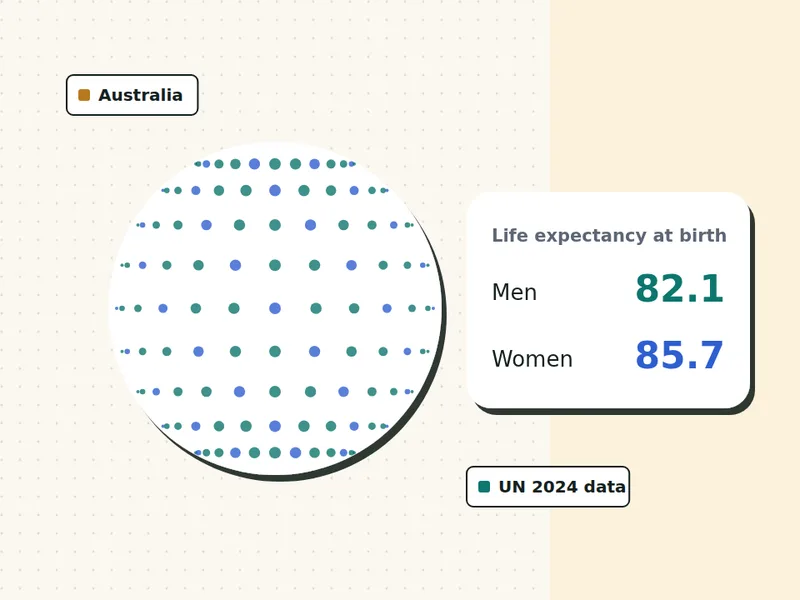
Life expectancy in Australia is about 82.1 years for men and 85.7 years for women at birth, according to UN World Population Prospects 2024 (2023 estimates). Adults can expect to live longer than that: a healthy 40-year-old man in Australia has an expected age at death of about 83.3, and a woman about 86.4. Use the calculator for your own estimate.
UN World Population Prospects 2024, 2023 estimates
- UN 2024 data, 201 countries
- Nothing stored or sent
- Free, no sign-up
On this page
What is the life expectancy in Australia?
At birth, life expectancy in Australia is 82.1 years for men and 85.7 years for women, a gap of 3.6 years. Among the 201 countries and territories in the UN data, that ranks Australia number 2 for men and 11 for women. These are period figures: how long a baby would live if today’s death rates never changed.
Australia has one of the highest life expectancies in the world, especially for men. Heart disease and dementia are leading causes of death. There is still a large gap in life expectancy between Aboriginal and Torres Strait Islander people and other Australians.
What do official statistics in Australia say?
The Australian Bureau of Statistics (ABS) reported life expectancy at birth of 81.1 years for males and 85.1 years for females for 2022 to 2024. The gap between men and women was 4.0 years, down from 5.9 years three decades ago.
Source: Australian Bureau of Statistics, Life expectancy, 2022 to 2024.
National offices often publish newer years or use different methods, so their figures can differ a little from the UN’s. We use the UN figures on our calculator so every country is measured the same way. Read more on data and sources.
Life expectancy by age in Australia
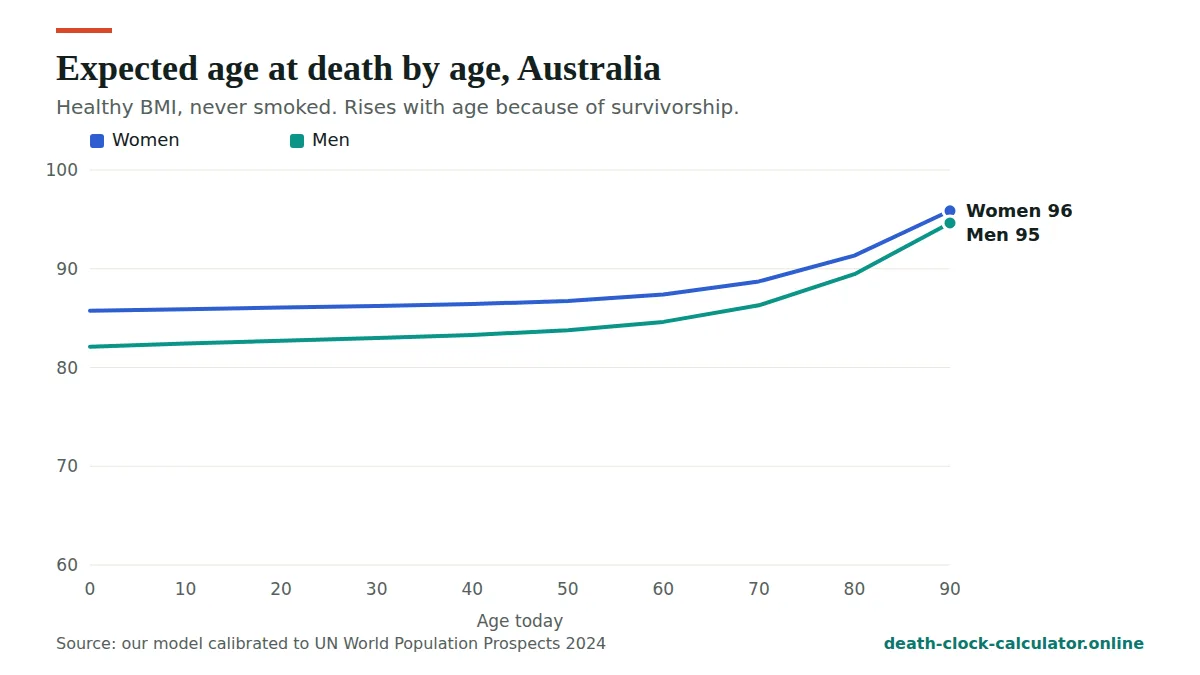
Your life expectancy rises as you get older, because you have already survived the years that pull the average down. The chart and table show our model for healthy non-smokers in Australia.
| Age today | Men: years left | Men: expected age at death | Women: years left | Women: expected age at death |
|---|---|---|---|---|
| 0 | 82.1 | 82.1 | 85.7 | 85.7 |
| 10 | 72.4 | 82.4 | 75.9 | 85.9 |
| 20 | 62.7 | 82.7 | 66.1 | 86.1 |
| 30 | 53.0 | 83.0 | 56.2 | 86.2 |
| 40 | 43.3 | 83.3 | 46.4 | 86.4 |
| 50 | 33.8 | 83.8 | 36.7 | 86.7 |
| 60 | 24.6 | 84.6 | 27.4 | 87.4 |
| 70 | 16.3 | 86.3 | 18.7 | 88.7 |
| 80 | 9.5 | 89.5 | 11.3 | 91.3 |
| 90 | 4.6 | 94.6 | 5.9 | 95.9 |
At 65, a healthy man in Australia can expect about 20.3 more years and a woman about 22.9, in our model.
What are the chances of living to 90 in Australia?
For a healthy 40-year-old who has never smoked, our model gives about a 30% chance of reaching 90 for men and 43% for women. Here are the odds for other ages:
| Group | Reach 70 | Reach 80 | Reach 90 | Reach 100 |
|---|---|---|---|---|
| Men | 88% | 68% | 30% | 2% |
| Women | 92% | 76% | 43% | 7% |
What age will people born in Australia live to?
This table shows the expected age at death and the projected year of death for people born in different years, calculated in September 2026 with today’s death rates. People born recently will probably live longer than shown, as health keeps improving.
| Born in | Men: age | Men: year | Women: age | Women: year |
|---|---|---|---|---|
| 1950 | 88 | 2038 | 90 | 2040 |
| 1960 | 86 | 2046 | 88 | 2048 |
| 1970 | 84 | 2054 | 87 | 2057 |
| 1980 | 84 | 2064 | 87 | 2067 |
| 1990 | 83 | 2073 | 86 | 2076 |
| 2000 | 83 | 2083 | 86 | 2086 |
| 2010 | 83 | 2093 | 86 | 2096 |
What are the leading causes of death in Australia?
| Group | Leading causes |
|---|---|
| Men 50 to 69 | Heart disease 14.1%, lung cancer 8.7%, bowel cancer 5.0% |
| Men 70 and over | Heart disease 14.1%, dementias 9.5%, stroke 5.7% |
| Women 50 to 69 | Lung cancer 10.9%, breast cancer 10.1%, heart disease 5.8% |
| Women 70 and over | Dementias 16.1%, heart disease 12.4%, stroke 8.1% |
2021 was a pandemic year, so COVID-19 ranks higher than it does now. For every age group and country, use our causes of death tool.
What would add the most years in Australia?
In Australia, heart disease, dementia and cancers dominate at older ages. Sun safety, not smoking, regular activity and a healthy weight are among the most useful habits.
Run the calculator above and open “What moves your estimate” to see how many years each change is worth for you. Our guide to how to live longer has the evidence for each habit.
Why life expectancy in Australia is among the highest in the world
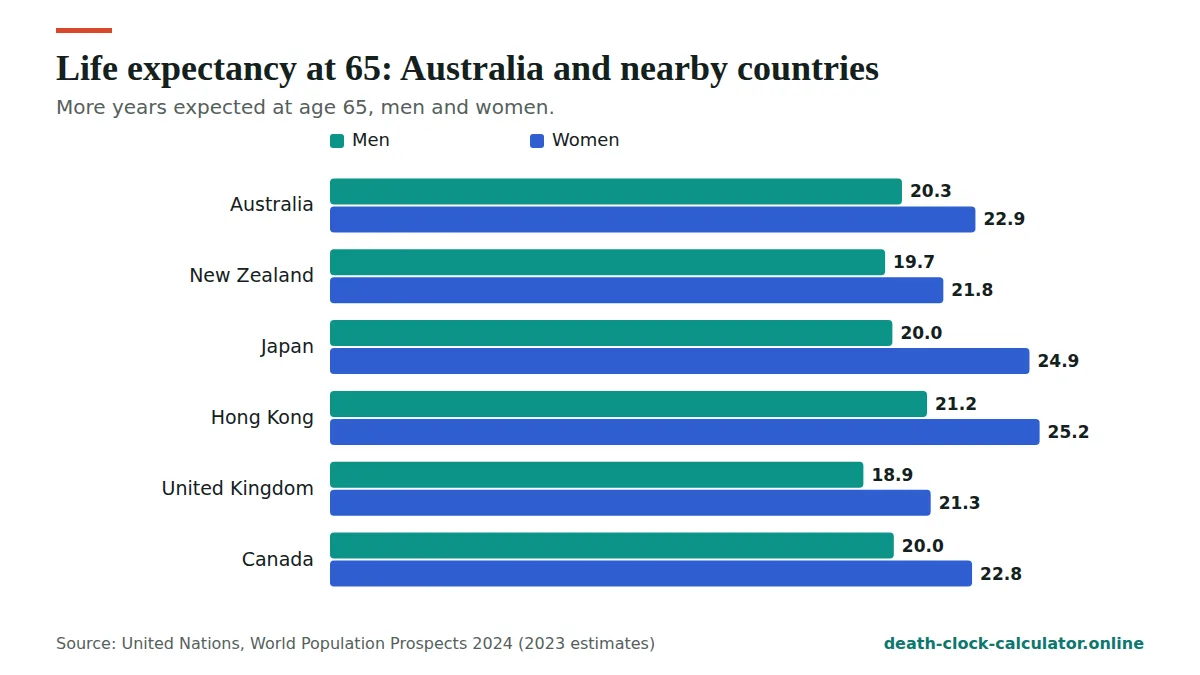
Among the 201 countries and territories in the UN data, life expectancy in Australia for men ranks 2nd at birth, behind only Hong Kong. Australian women rank 11th. At 65 the picture holds: men rank 3rd for the years they have left, and women 12th. These ranks are our own count from UN World Population Prospects 2024 (2023 estimates).
Few places come close to that for men. It means life expectancy in Australia is high not because one group does very well, but because both young and old adults die at low rates by world standards.
For a healthy adult, that makes the headline figure for life expectancy in Australia a fair starting point. In our model, a healthy 40-year-old man has an expected age at death of about 83.3, only 1.2 years above the at-birth figure of 82.1.
ABS and UN figures for life expectancy in Australia
You will see two sets of numbers for life expectancy in Australia. The Australian Bureau of Statistics (ABS) reported 81.1 years for males and 85.1 for females, averaged over 2022 to 2024. The UN estimate for the single year 2023 is about 82.1 and 85.7.
The UN figure is about 1.0 year higher for men and 0.6 years higher for women. The two cover different periods and use different methods, so small gaps like this are expected. The ABS figure is the official measure of life expectancy in Australia. We use the UN figure in the calculator so that life expectancy in Australia is measured the same way as every other country. Our page on how we calculate explains the steps.
Life expectancy in Australia compared with New Zealand and Asia
The table sets life expectancy in Australia beside its nearest neighbour and the Asia-Pacific places with the longest lives, plus the United Kingdom for a familiar reference.
| Country or territory | Men at birth | Women at birth | Men at 65 | Women at 65 |
|---|---|---|---|---|
| Australia | 82.1 | 85.7 | 20.3 | 22.9 |
| New Zealand | 80.4 | 83.8 | 19.7 | 21.8 |
| Hong Kong | 82.8 | 88.1 | 21.2 | 25.2 |
| Japan | 81.7 | 87.7 | 20.0 | 24.9 |
| Singapore | 81.2 | 86.2 | 20.0 | 23.5 |
| South Korea | 81.2 | 87.2 | 18.6 | 23.6 |
| United Kingdom | 79.4 | 83.2 | 19.0 | 21.3 |
Life expectancy in Australia and New Zealand
Australians live longer than New Zealanders at every point in the table. At birth the lead is about 1.7 years for men and 2.0 years for women. At 65 it narrows to about 0.6 years for men and 1.1 years for women. We worked these out from UN World Population Prospects 2024 (2023 estimates).
Australia and Japan
Japan is often held up as the benchmark for long lives. For men, life expectancy in Australia is actually a little higher: about 0.4 years at birth and 0.3 years at 65. For women the order flips. Japanese women live about 2.0 years longer at birth and about 1.9 years longer from 65.
So the high ranking of life expectancy in Australia comes mostly from its men. Australian women live long lives too, but several places in East Asia and Europe do better for women.
The narrow gap between men and women in Australia
In the UN data, women in Australia live about 3.6 years longer than men at birth. The average gap across the 201 countries and territories is 5.2 years, and only 33 places have a narrower gap. Australia ranks 168th of 201 for the size of its gap. We worked this out from UN World Population Prospects 2024 (2023 estimates).
The ABS puts the gap at 4.0 years for 2022 to 2024, down from 5.9 years three decades ago. Both sources point the same way. Men have been catching up with women, and that is a big reason life expectancy in Australia now sits near the top of world tables.
At 65 the gap is about 2.6 years, close to the world average of 2.7. So the narrow gap in Australia is mostly about fewer deaths among men before old age.
What healthy adults can expect from life expectancy in Australia
These figures for life expectancy in Australia come from our model and are estimates for people with a healthy BMI who never smoked. They describe large groups, and real lives spread widely around them.
- A healthy 40-year-old man has an expected age at death of about 83.3. He has an 88% chance of reaching 70, 68% of reaching 80 and 30% of reaching 90.
- A healthy 40-year-old woman has an expected age at death of about 86.4. She has a 92% chance of reaching 70, 76% of reaching 80 and 43% of reaching 90.
- At 60, the expected age at death rises to about 84.6 for men and 87.4 for women.
- At 80, it is about 89.5 for men and 91.3 for women.
Reaching 100 is still rare: about 2% for men and 7% for women, from a healthy 40-year-old start. A healthy 30-year-old woman has about 20,534 days left in our model. To see the age you might reach, try what age will I die, and to compare ages across countries, see life expectancy by age.
Life expectancy in Australia is not the same for everyone
The national average hides real differences. There is still a large gap in life expectancy between Aboriginal and Torres Strait Islander people and other Australians. Life expectancy in Australia also tends to be lower in remote areas and in poorer communities, where doctors and hospitals can be harder to reach.
The UN gives one figure for life expectancy in Australia as a whole, and our calculator starts from that figure. If your community’s figures are lower than the national one, the calculator may overstate your estimate. Treat it as a rough guide, not a verdict.
Everyday steps that matter most in Australia
The causes of death table on this page shows heart disease, lung cancer, bowel cancer, breast cancer and dementias near the top. That gives a practical list for Australians who want to shift their own odds:
- Protect your skin. Use shade, a hat and sunscreen, and see a doctor about any new or changing spot.
- Don’t smoke. Lung cancer is the top cause of death for women aged 50 to 69 and high on the list for men.
- Do bowel and breast screening when invited. Both cancers appear in the table for people aged 50 to 69, and both are easier to treat when found early.
- Look after your heart. Get your blood pressure and cholesterol checked, and keep a healthy weight. See BMI and life expectancy.
- Keep moving as you age. Walking, swimming and strength work help the heart and the brain, and may lower dementia risk.
- Keep alcohol low. Less is better for the heart, the liver and cancer risk.
The calculator above starts from life expectancy in Australia for your age and sex, then shows what each habit is worth for you. If thinking about these numbers makes you uneasy, our page on coping with death anxiety offers calm, practical help.
Frequently asked questions
What is the average life expectancy in Australia?
According to UN World Population Prospects 2024, life expectancy at birth in Australia was about 82.1 years for men and 85.7 years for women in 2023. Adults who have already passed childhood and young adulthood can expect to live longer than these figures.
How long do men live in Australia?
Men in Australia have a life expectancy at birth of about 82.1 years. In our model, a healthy 40-year-old man who has never smoked has an expected age at death of about 83.3, and a 65-year-old man can expect about 20.3 more years.
How long do women live in Australia?
Women in Australia have a life expectancy at birth of about 85.7 years. In our model, a healthy 40-year-old woman has an expected age at death of about 86.4, and a 65-year-old woman can expect about 22.9 more years.
Why do women live longer than men in Australia?
Women in Australia live about 3.6 years longer at birth. In most countries, men smoke and drink more, die more often from injuries and heart disease at younger ages, and see doctors less. Some biological protection for women also plays a part.
How can I estimate my own life expectancy in Australia?
Use the calculator on this page. It starts from the UN figure for Australia, adjusts for your age and sex, and applies published effects of BMI, smoking, alcohol, activity, diet and outlook. Everything runs in your browser and nothing is stored.
Why is the ABS figure different from the UN figure?
The ABS reported 81.1 years for males and 85.1 for females, averaged over 2022 to 2024. The UN estimate for 2023 alone is about 82.1 and 85.7. The two cover different periods and use different methods. The ABS figure is the official one, and we use the UN figure so every country is measured the same way.
Do Australians live longer than New Zealanders?
Yes, on average. In UN World Population Prospects 2024 (2023 estimates), Australians live about 1.7 years longer at birth for men and 2.0 years for women. From 65, the lead is smaller: about 0.6 years for men and 1.1 years for women. Both countries rank well above the world average.
Is life expectancy in Australia higher than in Japan?
For men, yes, by a little. Australian men live about 0.4 years longer than Japanese men at birth in the UN data. For women it is the other way round: Japanese women live about 2.0 years longer. Compare more places on life expectancy by country.
How likely is a healthy 40-year-old in Australia to reach 90?
For a healthy 40-year-old who never smoked, our model gives about a 30% chance of reaching 90 for men and 43% for women. These odds start from life expectancy in Australia and assume a healthy BMI. Your own habits move them up or down, which the death clock calculator can show you.
Compare Australia with every other country on life expectancy by country, or go back to the death clock calculator.
See your own estimate in 30 seconds
Free, private and based on UN 2024 data for 201 countries. Nothing you enter is stored.
Open the death clock →