
What Is BMI in Death Clock?
The BMI meaning in a death clock is body mass index. Its full form is Body Mass Index. It is your weight in kilograms divided by your height in metres squared. The death clock asks for it because risk of death is lowest at a BMI of about 20 to 25 and rises when BMI is well below or above that.
- UN 2024 data, 201 countries
- Nothing stored or sent
- Free, no sign-up
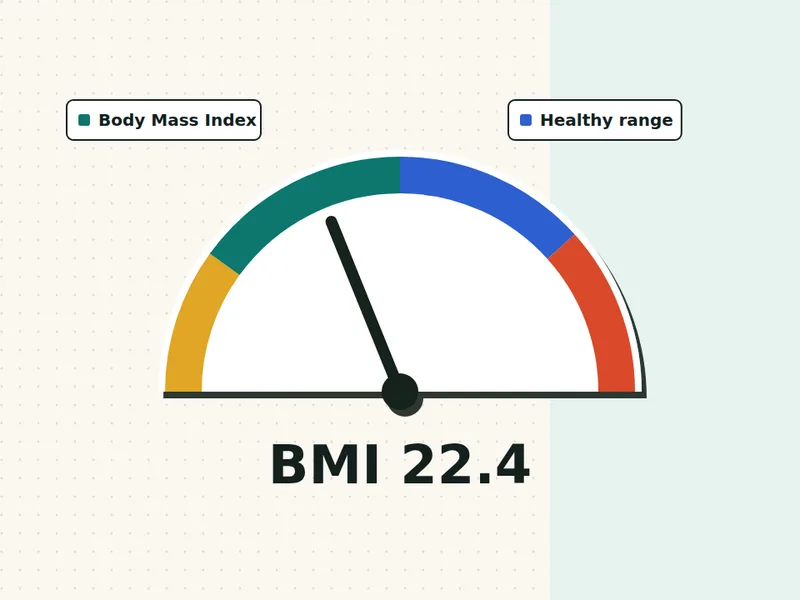
On this page
How do I work out my BMI?
Enter your weight and height below. Tick the box for Asian cut-offs if you are of South Asian, East Asian or Southeast Asian origin.
The formula is simple: BMI = weight (kg) ÷ height (m)². For example, 70 kg and 1.70 m gives 70 ÷ (1.70 × 1.70) = 24.2. In pounds and inches it is weight (lb) × 703 ÷ height (in)².
Once you know your number, pick the matching band in the death clock calculator. There is also a “Calculate my BMI” helper inside the calculator itself.
What is BMI in death clock results? The bands we use
| BMI | Standard label | Asian cut-off label |
|---|---|---|
| Under 18.5 | Underweight | Underweight |
| 18.5 to 22.9 | Healthy | Healthy |
| 23 to 24.9 | Healthy | Increased risk |
| 25 to 27.4 | Overweight | Increased risk |
| 27.5 to 29.9 | Overweight | High risk |
| 30 and above | Obesity (classes 1 to 3) | High risk |
People of Asian origin tend to carry more body fat at the same BMI and face higher diabetes and heart risk at lower BMIs. That is why many Asian health bodies use the lower cut-offs. The death clock itself uses the global study bands below.
How much does BMI change the death clock result?
The death clock uses hazard ratios from the Global BMI Mortality Collaboration, which pooled 239 studies across four continents (The Lancet, 2016). The lowest risk was at a BMI of about 20 to 25. Above 25, each 5 points raised the death rate by about 31%. Here is what that means in years, in our model:
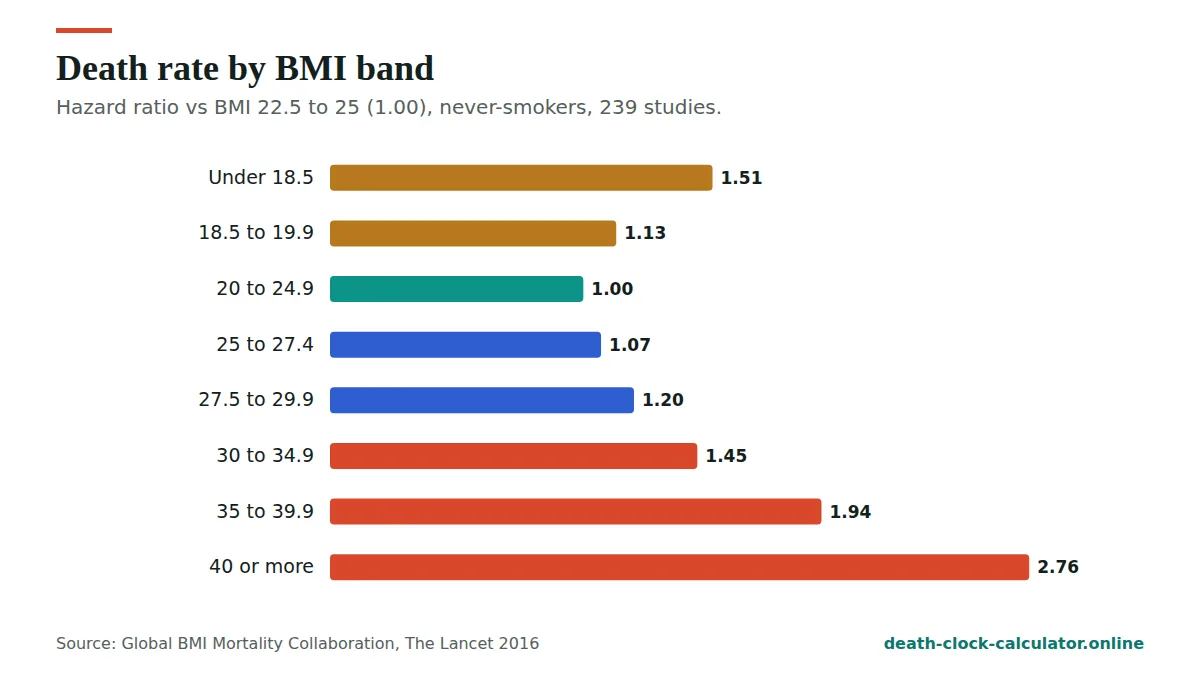
| BMI band | Hazard ratio used | Men: change in years | Women: change in years |
|---|---|---|---|
| Under 18.5 | 1.51 | -3.9 | -3.9 |
| 18.5 to 19.9 | 1.13 | -1.2 | -1.2 |
| 20 to 24.9 | 1.00 | reference | reference |
| 25 to 27.4 | 1.07 | -0.7 | -0.6 |
| 27.5 to 29.9 | 1.20 | -1.7 | -1.7 |
| 30 to 34.9 | 1.45 | -3.6 | -3.5 |
| 35 to 39.9 | 1.94 | -6.3 | -6.2 |
| 40 or more | 2.76 | -9.6 | -9.5 |
Very low BMI also raises risk. Sometimes that is because illness causes weight loss, so a low number is worth checking with a doctor. More detail is on BMI and life expectancy.
What is BMI in death clock results, and what is outlook?
“Outlook” means your general view of life: how hopeful you feel and whether you have a sense of purpose. It is optional. Long studies have found that more optimistic people and people with a stronger sense of purpose tend to live longer, even after allowing for health and habits. The effect is smaller than smoking or BMI, so the calculator gives it a small weight. If you choose “Prefer not to say”, it has no effect.
What do the other death clock inputs mean?
Date of birth. Used to work out your exact age today. It is the most important input.
Sex. Chooses the men’s or women’s survival curve for your country. Women live longer in almost every country.
Country. Where you live now. It sets your baseline from UN World Population Prospects 2024. Choose the country you have lived in for most of your adult life if you have recently moved.
Smoking. Whether you smoke now, used to smoke, or never smoked. If you quit, enter the age you stopped. Quitting earlier gives back more years.
Alcohol. How often you drink. Less is better for health overall. Choose “Prefer not to say” to leave it out.
Physical activity. Minutes of moderate exercise a week, such as brisk walking. The WHO target for adults is 150 to 300 minutes.
Diet. Your usual eating pattern. Mediterranean-style and whole-food diets score best.
Every source is listed on how we calculate.
BMI full form in death clock: Body Mass Index
The BMI full form in death clock questions is Body Mass Index. “Body” because it describes your whole body. “Mass” because it starts from your weight. “Index” because it boils everything down to one number you can compare with a simple chart.
Is the full form of BMI in death clock tools different from a doctor’s BMI?
No. The full form of BMI in death clock tools is exactly the same as at your doctor’s surgery. There is no special death clock version of BMI. It is the standard adult measure used by doctors and by the large studies behind our calculator.
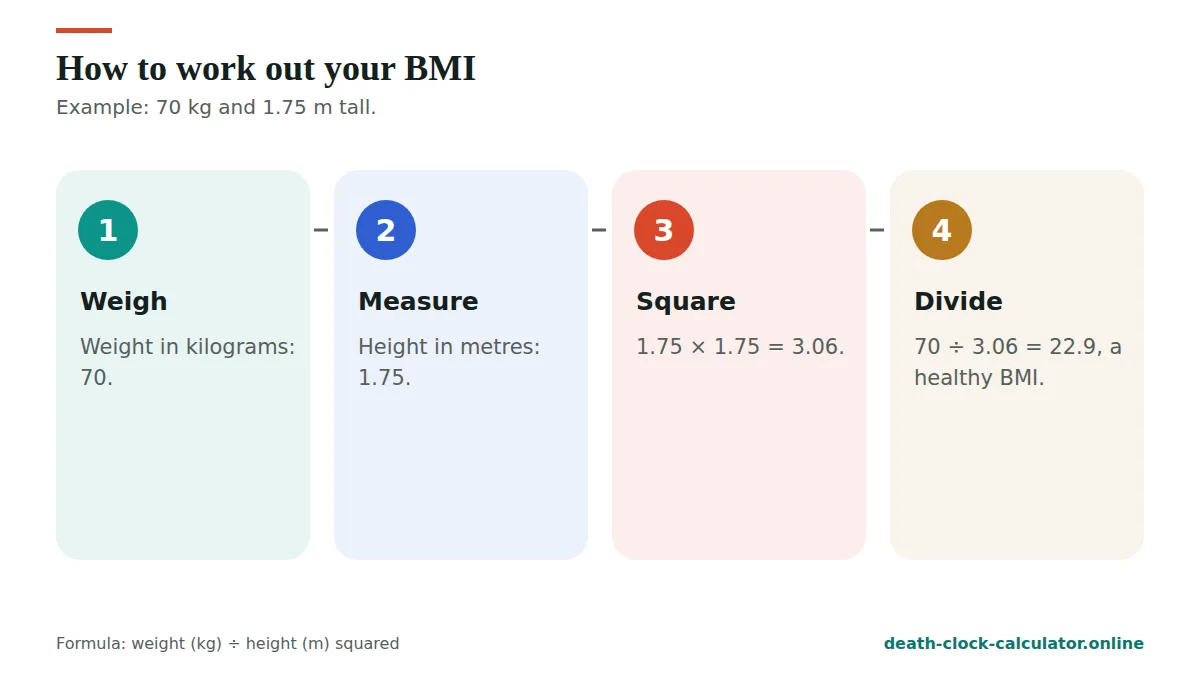
How to work out your BMI by hand, step by step
The helper above does the maths for you. If you would rather check what is BMI in death clock terms for yourself, you only need a scale, a tape measure and the calculator on your phone.
- Weigh yourself. Use the same scale each time, ideally in the morning, in light clothes.
- Measure your height. Stand straight against a wall with no shoes on. Mark the top of your head and measure from the floor.
- Change your height to metres. Divide centimetres by 100. So 165 cm becomes 1.65 m.
- Square your height. Multiply it by itself: 1.65 × 1.65 = 2.72.
- Divide your weight by that number. For 62 kg: 62 ÷ 2.72 = 22.8.
- Round to one decimal place and find your band in the table higher up this page.
In this example, a BMI of 22.8 sits in the healthy range on both the standard and the Asian scale.
Working it out in pounds, feet and inches
First turn your height into inches only. There are 12 inches in a foot, so 5 ft 6 in is 5 × 12 + 6 = 66 inches. Then use BMI = weight (lb) × 703 ÷ height (in)².
For someone who weighs 150 lb and is 66 inches tall: 150 × 703 = 105,450. Then 66 × 66 = 4,356. Finally 105,450 ÷ 4,356 = 24.2. That is healthy on the standard scale, and in the “increased risk” range on the Asian scale. The unit you use changes the working, not the BMI meaning in death clock results.
Worked examples
| Height | Weight | Working | BMI | Band to pick |
|---|---|---|---|---|
| 1.75 m | 55 kg | 55 ÷ (1.75 × 1.75) | 18.0 | Under 18.5 |
| 1.60 m | 50 kg | 50 ÷ (1.60 × 1.60) | 19.5 | 18.5 to 19.9 |
| 1.65 m | 62 kg | 62 ÷ (1.65 × 1.65) | 22.8 | 20 to 24.9 |
| 1.75 m | 80 kg | 80 ÷ (1.75 × 1.75) | 26.1 | 25 to 27.4 |
| 1.65 m | 80 kg | 80 ÷ (1.65 × 1.65) | 29.4 | 27.5 to 29.9 |
| 1.80 m | 100 kg | 100 ÷ (1.80 × 1.80) | 30.9 | 30 to 34.9 |
BMI meaning in death clock answers: picking the right band
The BMI meaning in death clock terms is simple: your number places you in one of eight bands, from “Under 18.5” to “40 or more”. The calculator then uses the risk level for that band. A few tips help you choose well.
- Use your weight today. Not your goal weight, and not what you weighed a few years ago. The estimate is about you as you are now.
- On a line? Go up. If you work it out by hand and land exactly on a boundary, such as 25.0, choose the band that starts at that number.
- Not sure? Use the “Calculate my BMI” helper inside the calculator. It picks the band for you. On some layouts you can also choose “I don’t know”, which leaves BMI out.
- Adults only. The bands are for adults. Children and teenagers are checked with growth charts that allow for age, and adult BMI charts are not meant for pregnancy.
- Very muscular? BMI can’t tell muscle from fat, so it may read high. Pick your honest band and read the result with that in mind.
If you have lost a lot of weight without trying, that is worth mentioning to a doctor, whatever your BMI number says.
Does the Asian box change the BMI meaning in death clock results?
The BMI helper on this page has a box that shows Asian cut-offs. Ticking it changes the label you see, not the number, and not the BMI meaning in death clock results. For example, a BMI of 24.2 shows as “healthy range” on the standard scale and as “increased risk” on the Asian scale.
So what is BMI in death clock scoring for Asian users? The same number and the same bands. The death clock itself sorts your number into the same eight bands for everyone, because those are the bands the global study reported. So if you are of South Asian, East Asian or Southeast Asian origin, treat the Asian label as an extra early warning, and enter your actual BMI band in the calculator as normal. The evidence behind the lower cut-offs is on BMI and life expectancy.
What is outlook in death clock questions?
So what is outlook in death clock tools? In short, it is an optional question about how you usually feel about life and the future. It is not a mental health test, and nobody sees your answer. Everything runs in your browser and is never sent to our server.
| Answer | What it means | Effect in the model |
|---|---|---|
| Very hopeful, strong sense of purpose | You usually expect good things and feel your days have a point | Risk behaves as if about 1 year younger |
| Mostly positive | Generally hopeful, with normal ups and downs | About 0.4 years younger |
| In between | Neither hopeful nor gloomy most of the time | No change |
| Often down or worried | Low or anxious much of the time | About 1 year older |
| Prefer not to say | You’d rather skip it | No change |
That is the whole answer to what is outlook in death clock scoring: a small nudge. These weights are small on purpose. The studies show a direction, not a clean number of years. Your outlook can also change, so answer for how you have felt over the past few months rather than today alone.
If thinking about this makes you anxious, or you often feel low, please be kind to yourself. Our death anxiety help page has calm, practical steps and ways to find support.
What is BMI in death clock results worth next to the other inputs?
Your date of birth, sex and country set the baseline. BMI and the optional answers then nudge risk a little higher or lower at every age. In our model, BMI uses the hazard ratios published by the Global BMI Mortality Collaboration directly. Smoking, alcohol, activity, diet and outlook are entered as “effective age”: a number of years your risk behaves as if you were older or younger.
In practice, the BMI meaning in death clock results depends on your band. A change in band can move your estimate by less than a year, or by several years at the far ends of the scale. The full table of weights is on how we calculate, and the years for each BMI band are in the table higher up this page.
To see what your own band is worth, run the death clock calculator and open “What moves your estimate”. If your band is not 20 to 24.9, it will show the change from reaching a healthy BMI, next to other changes you could make.
Common mistakes with the BMI input
Knowing the BMI full form in death clock tools is the easy part. Most wrong answers come from small slips, not from the maths. Here are the ones we see most often, and how to avoid them.
- Mixing units. Kilograms go with metres, and pounds go with inches. Using kilograms with inches, or centimetres without dividing by 100, gives a number that makes no sense.
- Forgetting to square the height. Dividing 70 kg by 1.70 m gives 41.2, which looks alarming. The right answer is 70 ÷ (1.70 × 1.70) = 24.2.
- Guessing your height. Many adults remember their height from years ago. People often lose a little height with age, so measure it again.
If you are still unsure what is BMI in death clock terms for you, let the helper work it out and pick the band it suggests.
What to do with your BMI result
Whatever your number, the answer to what is BMI in death clock results is the same: a starting point for a conversation, not a verdict. It says nothing about your worth, and it can’t see your fitness, your diet or your family history. Treat it as one piece of information among many.
If your BMI sits outside the healthy range, a doctor or practice nurse can look at your whole picture. They may also check your waist size and blood pressure. Small, lasting changes to what you eat and how much you move tend to matter more than quick diets. Ideas that have good evidence behind them are on how to live longer.
If your BMI is low and you have not been trying to lose weight, it is worth a check too. Very low weight can sometimes be a sign of illness.
Quick recap: what is BMI in death clock tools?
Here is the short version, in five lines.
- What is BMI in death clock tools? Body Mass Index, your weight in kilograms divided by your height in metres squared.
- Why ask for it? Risk of death is lowest at a BMI of about 20 to 25 and rises well below or above that.
- How to find it: use the helper, or work it out by hand with the steps above.
- What is outlook in death clock tools? An optional question about hope and purpose, with a small effect.
- Privacy: every answer stays on your device.
Once you know what is BMI in death clock terms for you, the rest takes under a minute. Remember that every result is an average for people like you, with a wide range, not a prediction about you.
Frequently asked questions
What is the full form of BMI in death clock?
BMI stands for Body Mass Index. It is your weight in kilograms divided by your height in metres squared. The death clock uses it because risk of death is lowest at a BMI of about 20 to 25.
What BMI should I choose if I don’t know it?
Use the BMI helper on this page or inside the calculator. Enter your weight and height, and it picks the right band for you. On the death date calculator, you can also choose “I don’t know”.
What does outlook mean in death clock?
Outlook means your general view of life: how hopeful you feel and whether you have a sense of purpose. Studies link optimism and purpose with longer lives. It is optional and has a small effect.
What is a healthy BMI for Indians and Pakistanis?
Many South Asian health bodies use lower cut-offs: 18.5 to 22.9 as healthy, 23 to 24.9 as overweight or increased risk, and 25 or more as obese or high risk. This is because health risks rise at lower BMIs in South Asian populations.
Is the BMI meaning in death clock tools the same as in a clinic?
Yes. The BMI meaning in death clock tools is the same Body Mass Index a doctor uses: weight in kilograms divided by height in metres squared. The only difference is that the death clock turns your band into a risk level. Work out your number with the helper, then pick the matching band in the death clock calculator.
Does the death clock save my weight and height?
No. On this site the maths runs in your browser. Your weight, height and other answers are never sent to our server, never stored and never included in analytics. You can read the details on our privacy policy page. Close the tab and your answers are gone.
Can I skip the outlook question?
Yes. If you are wondering what is outlook in death clock tools, it is an optional question about hope and purpose. Choose “Prefer not to say” and it has no effect at all. Even when you answer, our weights are small on purpose, at most about one year either way in the model.
Should I use the BMI input if I am pregnant?
No. The BMI meaning in death clock tools comes from adult charts, and those are not meant for pregnancy, because weight changes for good reasons. Choose “I don’t know” if that option is shown, or ask your midwife or doctor. The rest of the calculator still works, and your result stays an average for people like you.
Ready? Enter your BMI band in the death clock calculator and see your estimate.
Data: United Nations, World Population Prospects 2024. Method: how we calculate.
See your own estimate in 30 seconds
Free, private and based on UN 2024 data for 201 countries. Nothing you enter is stored.
Open the death clock →