
Death Clock Resources
These death clock resources help you understand life expectancy, check our numbers and find support. You’ll find every calculator, plain-English guides, a glossary, free country data you can download, and help if thinking about death makes you anxious. Everything here is free and sourced.
- UN 2024 data, 201 countries
- Nothing stored or sent
- Free, no sign-up
On this page
Death clock calculators
Every tool uses the same survival model and UN 2024 data, so the numbers always agree. Pick the view that answers your question best.
- Death clock calculatorThe full estimate: age, date, range, countdown and what moves it.
- Death date calculatorA quick calendar answer from your date of birth.
- Age at death calculatorYour odds of reaching 70, 80, 90 and 100.
- Death countdownDays left, with a live timer.
- When will I die quizNine questions, one at a time.
- Life expectancy calculatorYears to plan for, for retirement and savings.
- Causes of death toolLeading causes by country, age and sex.
- World death clockDeaths and births worldwide, per second.
Guides to life expectancy
- Is the death clock real?What it gets right and what no tool can know.
- How to live longerThe habits with the biggest proven gains.
- Life expectancy by countryMen and women in 201 places.
- Life expectancy by ageYears left at every age.
- Smoking and life expectancyYears lost and won back.
- BMI and life expectancyWhat 10.6 million adults showed.
- Every input explainedBMI, outlook and the other questions.
- Astrology and death datesWhat the evidence says.
Life expectancy in your country
Country guides with local figures, years left at every age and the most common causes of death.
Death clock resources for reference and data
Support if you feel anxious
We keep adding to these death clock resources as new UN and WHO data comes out. If there is a guide or tool you would like to see, tell us through our contact page. Every resource here follows our editorial policy: sourced, checked and written in plain English. The underlying data is published by the United Nations and the World Health Organization.
Thinking about death is normal, but it can also stir up worry. Our death anxiety help page has practical ideas and free helplines in several countries.
If you are feeling low
If this topic is weighing on you, please talk to someone today. You do not need to be in crisis to call.
- United States: call or text 988 (988 Suicide and Crisis Lifeline)
- United Kingdom and Ireland: Samaritans, call 116 123 for free
- India: Tele-MANAS, call 14416 (free, 24 hours, government of India)
- Anywhere else: findahelpline.com lists free, confidential helplines by country
If you are in danger right now, call your local emergency number.
Which death clock resources should you start with?
There are a lot of pages on this site, so here is a quick way to find the right one. Pick the goal that sounds most like yours.
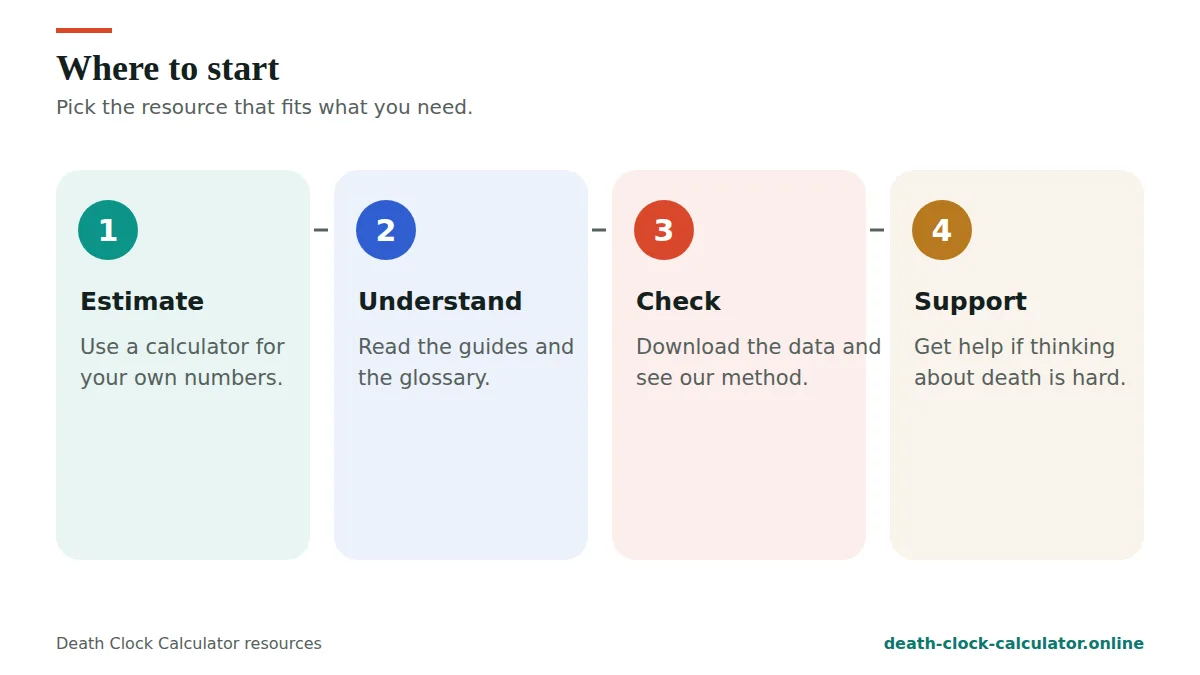
| If you want to | Start with | Then try |
|---|---|---|
| Get a personal estimate | Death clock calculator | What age will I die |
| See a date or countdown | Death date calculator | Death countdown |
| Plan money for later life | Life expectancy calculator | Life expectancy by age |
| Add healthy years | How to live longer | Smoking and life expectancy |
| Compare countries | Life expectancy by country | Data and sources |
| Check how it works | Is the death clock real? | How we calculate |
| Feel calmer about death | Death anxiety help | Death clock FAQ |
All of these death clock resources use the same model and the same UN 2024 data, so the numbers on one page will match the numbers on another.
Death clock resources for planning ahead
Many people use a death clock to think about retirement, savings or care. For that, a range is more useful than a single date. These death clock resources are built for planning:
- Life expectancy calculator. Shows ages to plan for, including ages that only a minority of people reach.
- What age will I die. Shows your chances of reaching 70, 80, 90 and 100.
- Life expectancy by age. Shows years left at every age for several countries.
To give a sense of the spread, here are model estimates for a 40-year-old with a healthy BMI who never smoked. In the United States, the chance of reaching 90 is about 23% for men and 34% for women. In the United Kingdom it is about 24% for men and 35% for women. Planning only for the average age would leave many people short. For money decisions, a qualified adviser can help.
Death clock resources for health and habits
The most useful part of any estimate is what can change it. These death clock resources explain the habits with the clearest evidence:
- Smoking. Lifelong smoking costs about 10 years on average (Doll and Peto, BMJ, 2004). Quitting wins much of it back. Read smoking and life expectancy.
- Weight. Risk of death is lowest at a BMI of about 20 to 25. Read BMI and life expectancy.
- Activity, diet and alcohol. Each has a measurable effect in large studies. Read how to live longer.
These guides share general information, not medical advice. If you have a health condition or symptoms, please talk to a doctor. Simple checks, such as blood pressure, can often be done at a pharmacy.
Death clock resources for students, teachers and writers
Life expectancy is a good topic for maths, geography and health lessons, and for articles. These death clock resources are free to use with credit:
- The country CSV. Life expectancy at birth and at 65 for men and women in 201 countries and territories, from UN World Population Prospects 2024.
- The glossary. 32 terms, such as survivorship, hazard ratio and life table, explained in plain English.
- The method page. The survival formula, constants and every study we use, with links.
- The FAQ. Short answers that are easy to quote.
Simple classroom ideas
- Rank countries by life expectancy and discuss why the top and bottom differ.
- Work out the gap between men and women for a few countries. Across all 201, the average gap is 5.2 years (UN World Population Prospects 2024, 2023 estimates).
- Compare life expectancy at birth with life expectancy at 65, and talk about survivorship.
- Look at why a range is more honest than a single date.
Please describe our model figures as educational estimates, not official statistics. The citation wording is on data and sources.
Death clock resources for your country
Where you live makes a big difference to life expectancy, so our country guides are some of the most used death clock resources on the site. Each one shows local figures, years left at every age and the most common causes of death.
- Australia has one of the highest figures in the world for men, at 82.1 years, second out of 201 countries and territories.
- Canada is close behind, with 80.4 years for men and 84.8 for women.
- Pakistan is lower, at 65.3 for men and 70.2 for women.
All figures are UN World Population Prospects 2024, estimates for 2023. If your country does not have its own guide yet, you will still find it in the full table on life expectancy by country.
How our death clock resources fit together
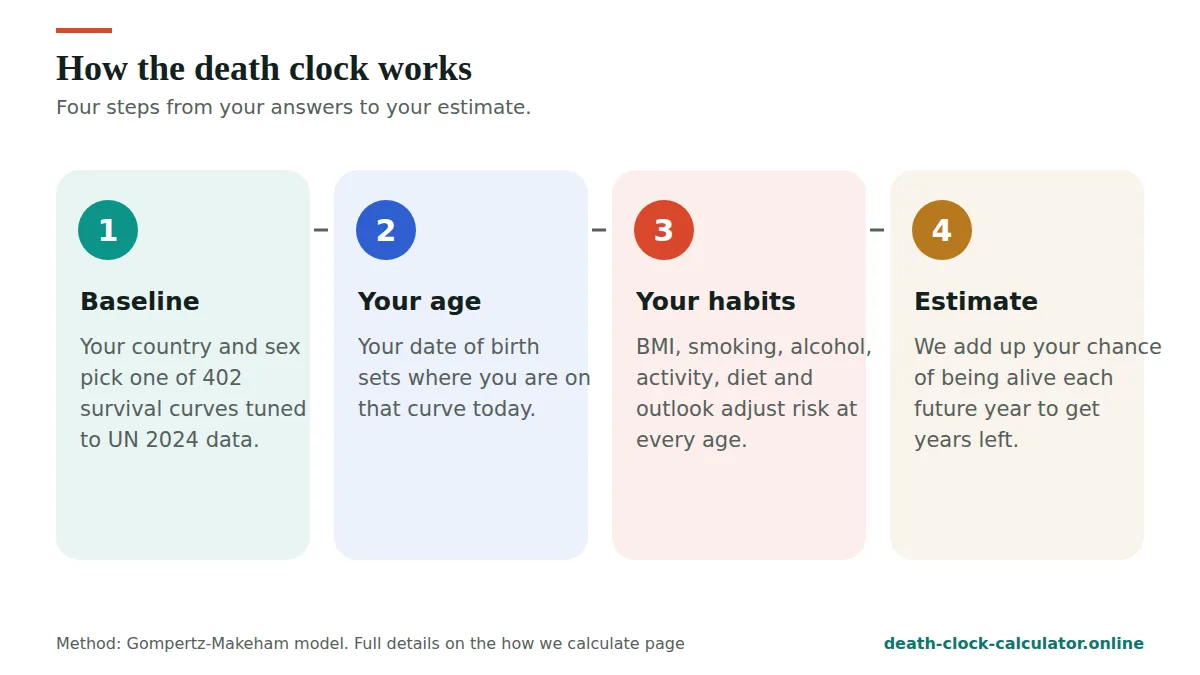
Every tool follows the same four steps, shown in the picture above. Knowing them makes it easier to move between pages.
- Baseline. Life expectancy for your country and sex from UN data.
- Your age. The average years left for people who have reached your age.
- Your habits. Optional answers that move the estimate up or down, based on published studies.
- Your estimate. An average age, a projected month and year, and a wide range around them.
The calculators show these steps as numbers. The guides explain each step in words. The glossary, FAQ and data pages let you check any part of them.
What makes these death clock resources worth trusting?
There are many sites about death dates. We try to earn trust in simple, checkable ways:
- Sourced numbers. Every figure comes from the UN, the WHO or a named, published study.
- A public method. The formula and constants are on one page for anyone to check.
- Ranges, not promises. Every result shows a range, because no tool can know one person’s date.
- Privacy. Calculations run in your browser. Your answers are not sent to us or stored.
- Free to use. No account and no payment. The site is paid for by display ads.
- Respect for beliefs. Our page on the astrology death calculator explains the evidence without mocking anyone.
Death clock resources if a result worries you
Looking at a number about your own life can bring up strong feelings. That is normal. If a result has unsettled you, it is fine to close the page and come back another day, or not at all.
Our death anxiety help page offers gentle, practical ideas, such as talking to someone you trust, limiting how often you check, and looking after your sleep. It also lists free support lines. Of all our death clock resources, it may be the most important one to share with a friend.
A suggested reading order
If you would like to work through our death clock resources in order, this path takes you from a first estimate to a full understanding:
- Get your estimate on the death clock.
- Read is the death clock real? to see what it can and cannot tell you.
- Look up any unfamiliar word in the life expectancy glossary.
- Pick one habit from how to live longer to work on.
- Check the numbers yourself on how we calculate.
We add new death clock resources when new data comes out, so this page will keep growing.
Death clock resources for carers and families
If you look after a parent, partner or relative, you may want a sense of how long care could be needed. Our tools can give group averages, but they cannot describe the person you care for. Their health, history and doctors matter far more than any average.
- Life expectancy by age. Shows average years left at older ages, which helps with rough planning.
- How will I die. Explains the most common causes of death by country, using WHO figures. See how will I die.
- Death anxiety help. Caring can be tiring and worrying. This page is for carers too.
For questions about one person’s outlook, their own doctor or care team is the right place to ask.
Death clock resources for people planning retirement
Retirement plans often fail because people plan for the average age and then live longer. These death clock resources help you plan for a longer life, not just a typical one.
| Country | Men | Women |
|---|---|---|
| United States | 23% | 34% |
| Canada | 29% | 42% |
| Australia | 30% | 43% |
The model also gives years left at older ages. For a healthy US man of 70 who never smoked, it estimates about 15.3 years left on average, and 17.5 for a woman. Many people will live longer than that, and many less.
- Use the life expectancy calculator to see a range of ages.
- Plan for an age in the upper part of that range, not the middle.
- Talk to a qualified financial adviser before making decisions.
If you feel uneasy after seeing your number
A single number about your own life can feel heavier than it should. Please keep three things in mind:
- It is a group average. It describes people like you on average, not you.
- The range is wide. Many people live well past the middle estimate.
- It is not a diagnosis. Only a doctor who knows you can talk about your health.
Reading is the death clock real? often helps, because it shows how rough these estimates are. If worry stays with you, our death anxiety help page has calm next steps.
Death clock resources if you are simply curious
Not everyone comes here to plan. Some people just want to see how the numbers work. These death clock resources are lighter to explore:
- When will I die quiz. A short set of questions with the same model behind it. See the when will I die quiz.
- World death clock. Shows how many deaths happen around the world over time, based on UN data.
- Astrology death calculator. Explains what the evidence says about star signs and lifespan.
Curious or not, the same rule applies to all our death clock resources: the results are group averages, never a date for you.
What we don’t offer
It helps to be clear about what our death clock resources cannot do:
- No medical advice. We share general information. We cannot assess symptoms, results or treatment.
- No individual predictions. No tool can know when a particular person will die. Our results are averages for groups with wide ranges.
- No financial or legal advice. Our planning figures are a starting point for a talk with a qualified adviser.
- No stored answers. Calculations run in your browser, so we cannot look up or send you past results.
The full terms are on our disclaimer page.
Frequently asked questions
What resources does Death Clock Calculator offer?
Eight free calculators and tools, guides to life expectancy and its causes, six country guides, a 32-term glossary, a free CSV of life expectancy for 201 countries, an FAQ and a support page with helplines.
Are the death clock resources free?
Yes. Every tool, guide and data file is free, with no account. The site is paid for by display ads only.
Can I use your data in my own work?
Yes, with a link back to our data and sources page. The country figures come from the UN World Population Prospects 2024, and our model tables are educational estimates, not official statistics.
Which death clock resources are best for retirement planning?
Start with the life expectancy calculator, which shows ages to plan for, then check your chances of reaching 90 or 100 on what age will I die. Plan for a longer life than the average, and talk to a qualified adviser before making money decisions.
Can teachers use these death clock resources in class?
Yes. The country CSV, the glossary and the method page are free to use with credit. They work well for lessons on data, geography and health. Please describe our model figures as educational estimates, and use the citation wording on the data and sources page.
Do all the death clock resources give the same answer?
They use the same survival model and the same UN 2024 data, so the numbers agree. Each tool shows a different view of the same estimate, such as a date, an age, a countdown or the chance of reaching a birthday. Pick whichever view is easiest for you to understand.
Is there a death clock resource for people who feel anxious?
Yes. Our death anxiety help page has gentle, practical ideas for coping with worry about death, and it lists free support lines. It is fine to stop using any calculator if the results upset you, and to come back later, or never, if that feels better.
See your own estimate in 30 seconds
Free, private and based on UN 2024 data for 201 countries. Nothing you enter is stored.
Open the death clock →